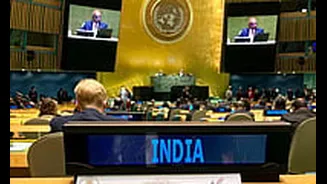

New Delhi: India on Friday cast a vote in Geneva at a Special Session, convened by the United Nations Human Rights Council (UNHRC) to protest the violence used by the Iranian state against protesters,
where New Delhi along with China and Pakistan voted against the resolution. Despite this, the 47- member body of the UNHRC saw 25 nations vote in favour of the resolution, seven against and 14 abstentions.
Iran’s Ambassador to India Mohammed Fathali responded to India’s vote on X stating. “I extend my sincere gratitude to the Govt. of India for its principled and firm support of I.R. of Iran at the UN_HRC, including opposing an unjust and politically motivated resolution. This stance reflects India’s commitment to justice, multilateralism, and national sovereignty.”
Experts say that India’s vote against UN resolutions targeting Iran on human rights is a long-held policy by the Indian government. Former foreign secretary Nirupama Rao decoded India’s stance post the vote. Writing on X, she said. “India explained its vote against the Iran resolution at the UN Human Rights Council in familiar terms: the text was selective, politicised, and unlikely to foster constructive engagement.” She added.
“New Delhi argued that country-specific resolutions often harden positions rather than improve human rights outcomes, and stressed dialogue, national processes, and capacity-building over public condemnation.” Rao’s statement regarding India’s stance was echoed by the diplomatic community. Senior diplomats point out that India has consistently refused to support UN resolutions that targeted Iran on human rights. In December 19, 2023, India voted against a UN resolution entitled ‘Situation of human rights in the Islamic Republic of Iran’ for various reasons.
A senior diplomat explained that this was linked to the fact that India has warm ties with Iran and New Delhi has been traditionally suspicious of UN resolutions focusing on human rights against a member country. India itself has been targeted by the UN on the issue of human rights. In 2024, the UNHRC in a report “voiced concern about discrimination and violence against minority groups.” It also “expressed concern that some provisions of India’s Armed Forces (Special Powers) Acts and counter-terrorism laws are not in compliance with the ICCPR (International Covenant on Civil and Political Rights).”
Tensions escalated further when in March last year, UN High Commissioner for Human Rights Volker Turk upset New Delhi with his remarks on Kashmir and and Manipur. Coming back to Iran, diplomats point out that while India provides support to Iran, the support largely remains on the issue of human rights. India has taken a very different view when it has come to the issue of Iran’s nuclear programme, though this has been prompted by political necessity. In September 2005 India voted with 21 other nations at on the International Atomic Energy Agency (IAEA) resolution finding Iran in noncompliance with safeguards with its nuclear agreement.
This stance was repeated in 2006. Analysts saw this vote coming as a result of the fact that India was seeking to negotiate its own nuclear programme, and that it was looking to show the world that it was a responsible nuclear power. Post its nuclear deal with the US, India has abstained on UN resolutions regarding the safety of Iran’s nuclear programme. The abstentions suggested that while New Delhi recognised Iran’s right to a nuclear programme, it also sought to emphasise to the world that being a responsible nuclear power was key to its concerns.
India’s position on Iran at the UN does not seem to have had much impact on India-Iran relations. Tehran has been quick to thank New Delhi and other nations personally when there has been a positive vote at the UN and voice its disappointment in general terms when the vote did not go its way. In the 2006 vote, which saw Russia and China also align with India, US, UK, France and Germany, Iran’s envoy to the IAEA chose to describe the passing of the resolution as a “hasty and undue step.”
The language here suggested that Iran saw there was a unified coalition and so it did not specifically target India. This has been the status quo so far. Diplomats also point out that it is also important to consider the platform, the body, and the nations that have voted when examining India’s vote against Iran. The recent UNHRC vote on human rights has little teeth because the Fact-Finding Mission that the UN body has asked to investigate human rights in Iran cannot enter the country without Iran’s express permission.
This is true of the IAEA as well, but this body’s resolutions can escalate matters to the UN Security Council quicker because of the global concern over Iran’s nuclear programme. So India’s vote depends on the body and the issue put forward. The more important the body, the more India’s vote counts, and the more the India-Iran relationship will be tested.