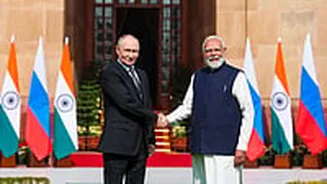

Russian President Vladimir Putin’s two-day visit to India on December 4 and 5 has infused fresh optimism among students and parents, particularly those exploring opportunities in medicine, engineering
and specialised technical fields. With New Delhi and Moscow signalling a renewed push for cooperation in education, culture and youth engagement, many now hope that the diplomatic warmth will lead to practical academic benefits.
Nearly 30,000 Indian students are currently enrolled in Russian universities, according to the Indian Embassy in Moscow. Most are pursuing programmes in medicine, engineering, economics and the sciences—areas that have drawn Indian interest for decades. Medical students form the largest group, even though many return home after graduation due to restricted paid opportunities within Russia’s publicly funded healthcare system.
Educational collaboration between India and Russia is not new. It spans multiple frameworks such as the Educational Exchange Programme, the India–Russia Network of Higher Education Institutions, SPARC and GIAN. Indology and Indian languages—including Hindi, Sanskrit and Pali—are taught across various Russian universities. At the school level, India’s Atal Innovation Mission and Russia’s SIRIUS Centre continue to run joint programmes initiated by Prime Minister Narendra Modi and President Putin.
In recent years, Russia has introduced an additional sixmonth visa extension to help graduates explore employment possibilities—an incentive that engineering and technology students view as a meaningful step. Interest is also rising in niche areas such as aeronautical, aviation and nuclear engineering. A growing number of Indian students are even taking up Russian, as several specialised courses continue to be offered in the local language.
Curiosity, Caution and Hope
Across campuses in India, Putin’s visit has sparked conversations tinged with expectation. Aarav Menon, a Political Science student at Delhi University, said the visit had become a discussion point in his department. “For us, this is a significant diplomatic moment. Among students, opinions are mixed—some see it as a sign of India’s confidence on the world stage, others feel uncertain because of Russia’s geopolitical situation. But most of us just hope it results in real opportunities: exchanges, internships, or greater foreign-policy exposure—not merely headlines.”
At VJTI Mumbai, engineering student Riya Shah echoed similar sentiments. “On our campus, politics is not the main focus. We care about technology. If ties strengthen, there may be new collaborations in robotics, AI or space technology. That is what matters to engineering students—opportunities that enhance research or employability.”
For medical students and parents, the visit carries particular weight. Sanchit Verma, a third-year MBBS student from Lucknow, said, “Many Indian students study medicine in Russia, so visits like this matter. They give hope that processes around degree recognition, visas and student support may improve. We are not thinking about geopolitics—we just want smoother pathways because so many Indian families rely on Russia for medical education.”
Russian Education Agency Opens Delhi Office
The diplomatic goodwill received a significant boost on Thursday with the opening of the Russian Education Agency’s New Delhi branch. The agency has been established jointly by Synergy Corporation and Innopraktika India, and is positioned as a dedicated bridge for academic exchanges.
Calling it an “important day,” Vadim Lobov, President of Synergy Corporation, said the new office would provide comprehensive information on Russian universities, programmes, professional skills and employment avenues. “We have waited for this visit for a long time. I’m confident that new areas of collaboration will emerge, and our agency will create a fresh bridge between students of both countries.”
Natalia Popova, First Deputy CEO of Innopraktika, said the agency’s presence would attract more Indian students to Russia. “We have a long history of Indian students who came to Russia and became very successful. They will continue to shape the innovation ecosystem in both countries and strengthen ties between high-tech industries.”
President Putin arrived in New Delhi just as the agency's event was underway, and was received by Prime Minister Narendra Modi at Palam Airport—a gesture reaffirming the nations’ political warmth.
Students & Parents Look Ahead
Students observing the developments say they now expect the momentum to translate into tangible academic gains. For many families, the wish list is simple: easier admissions, stronger institutional partnerships, smoother visa processes and better recognition of qualifications.
If the renewed diplomatic energy results in clearer pathways and broader academic opportunities, students and parents believe this visit may well mark the beginning of a more confident and collaborative India–Russia education landscape.