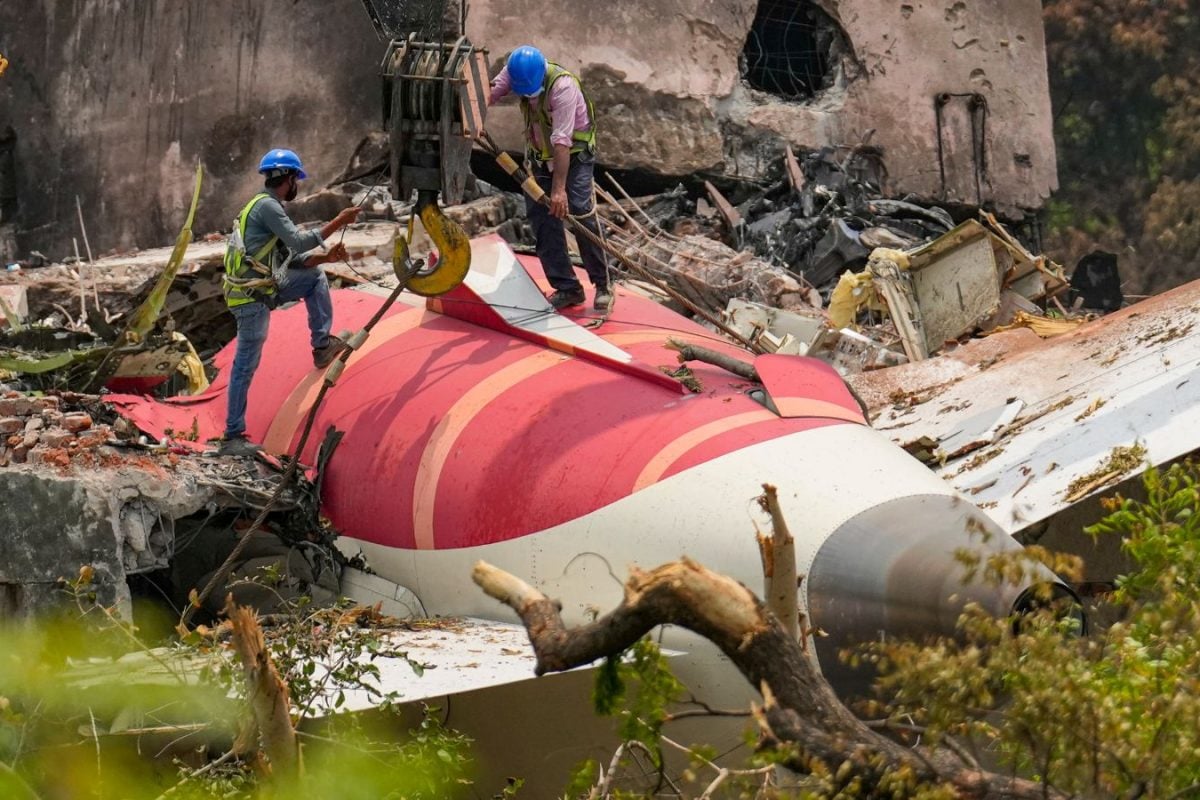









Chennai, Jan 20: A whistleblower report submitted to the US Senate Permanent Subcommittee on Investigations (PSI) shows that the Air India Boeing 787-8 AI-171, which crashed 32 seconds after take-off on June
12, 2025, killing 260 people, had a long history of electrical and computing system faults, including a major electrical fire in 2022 and subsequent replacements of core system components.
Findings submitted to US Senate panel
The Foundation for Aviation Safety (FAS), which presented the material to the PSI on January 12, 2026, told the committee that VT-ANB’s (VT being the registration code indicating it is Indian and ANB the unique identification of the aircraft) problems began “the very first day” the aircraft arrived in India on February 1, 2014, and continued throughout its 11-year life.
Boeing has a real-time, live transmission of faults under its Aircraft Health Management (AHM), transmitted via satellite by providers such as Inmarsat and SITA to clients like Air India.
Wide range of electrical issues cited
The submission to the Senate describes a “wide variety” of issues, including repeated circuit-breaker trips, avionics and software faults, wire damage, smoke and fumes, short circuits, loss of electrical current, electrical surges, burning, and overheating of power-distribution components — “including a very serious fire”.
Details of 2022 electrical fire
In the most detailed example cited, the Senate submission states that in January 2022 the aircraft had a fire in its P100 Primary Power Panel, resulting in “extensive burning around the L2 Bus Tie Breaker (BTB) and surrounding wiring”.
The damage was so extensive, the document says, that the entire power panel had to be replaced. Photographs included with the submission show black soot and fire damage in the aft electronics bay, where the panel is located.
The submission characterises the P100 as a critical power distribution unit, receiving power from the left engine and distributing it to various vital aircraft systems.
Subsequent grounding and component replacements
Three months later, in April 2022, the report says VT-ANB was grounded again due to “confusing faults” involving the landing-gear indication system.
Air India replaced a proximity sensing data concentrator module, the left Common Core System (CCS) remote data concentrator in the aft electronics bay, and a Remote Power Distribution Unit (RPDU) power module, the submission states.
Concerns over latent defects
FAS frames the pattern as potentially consistent with “latent defects” — hidden flaws in an aircraft’s design, manufacturing, or maintenance that can remain undetected for years until triggered — and with the “normalisation of deviance”, where known defects are repeatedly tolerated until they come to be viewed as normal.
Broader implications for 787 fleet
Beyond VT-ANB, the submission states that Air India’s other 787 aircraft show evidence of electrical system failures, and that US-, Canadian- and Australian-registered 787 aircraft are experiencing similar system failures.
Manufacturing quality issues highlighted
Ed Pierson, executive director of the Foundation for Aviation Safety, linked VT-ANB’s history to early manufacturing quality concerns in the 787 programme. “You see VT-ANB (AI-171) was only the twenty-sixth 787 built (line number 26), and back then the 787 factory in Everett, Washington, was known to be having a lot of manufacturing quality issues,” Pierson, who is also a military veteran and a former Boeing senior manager, told The Free Press Journal.
Senate panel members and next steps
The Senate subcommittee’s chair is Ron Johnson, with members including Richard Blumenthal, James Lankford, Rick Scott, Josh Hawley and Bernie Moreno on the Republican side, and Democratic representation from Maggie Hassan, John Fetterman, Andy Kim, Rand Paul and Gary Peters.
The evidence has been taken on record. No Air India or Boeing representatives were present during the presentation of evidence to the Senate subcommittee members.
Also Watch:
The Senate submission urges US authorities to ensure full disclosure of this material to the ongoing AAIB-led investigation, and recommends that the FAA thoroughly investigate 787 system-failure reports and conduct inspections across the fleet.