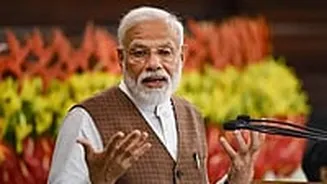







Prime Minister Modi’s recent visit to Oman was viewed with keen interest by observers both in Delhi and Muscat. The visit, which was the Prime Minister’s second visit to Oman, saw the signing of two key
documents between India and Oman—the joint vision maritime document and the Comprehensive Economic Partnership Agreement (CEPA). Long sought by both Delhi and Muscat, negotiations for the CEPA began in November 2023, and it was formalised on December 17 this year. Under the trade agreement, more Indian companies are likely to set up shop in Oman, and given that Muscat has an open border with other Gulf nations, India will be able to strengthen its economic footprint in West Asia.
On the defence side, attention needs to be paid to the joint vision maritime document, the first such document signed by India with a West Asian country. While both India and Oman have a naval history, the presence of the British, who did not wish to relinquish control over defence and security in Oman, and New Delhi’s own reluctance to explore a naval partnership meant that this aspect of the relationship was not expanded upon till recently.
Today, the situation is vastly different. The Great Power conflict within the Indian Ocean means that increased maritime cooperation with Oman is crucial to India’s interests. Oman’s strategic location on the Strait of Hormuz and its long coastline in the western part of the Indian Ocean make it imperative for New Delhi to have a naval presence there. The joint naval doctrine will enable New Delhi to have an increased presence in the region, ensure existing Sea Lanes of Communication (SLOC) are maintained and strengthen India’s blue economy.
Prime Minister Modi is not the first Indian leader to recognise the significance of Oman. India has civilisational ties that go back 5,000 years, and Sultan Qaboos bin Said, the former ruler of Oman, had sought for New Delhi to play a strategic role there in the 1990s. Though that has not materialised to this date, Oman can play a significant role for India. Unlike the high-profile role adopted by the UAE and Qatar, the country is valuable as it has good relations with the Gulf nations, Iran, and even the Houthis. India would note this with great interest with regard to Iran.
Though New Delhi has good relations with Iran, secondary sanctions imposed by the Trump administration and the revocation of the sanctions exemption on the Chabahar Port mean there is an element of caution in engaging Tehran today. It is here that the Gulf nation can play a role in conveying messages and holding talks that would not attract as much public attention as they would if held in Tehran or New Delhi. Oman is key to India’s West Asia strategy, and New Delhi must make use of it.