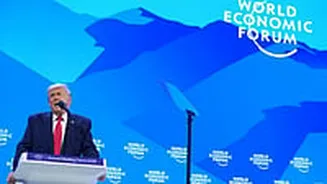

The thaw in Davos may have cooled the immediate threat of a trade war, but it has only served to enhance Greenland's status as the ultimate geopolitical prize. While US President Donald Trump used his
World Economic Forum address to rule out military force, the strategic scrutiny on the Arctic island is far from over as it has emerged as a central flashpoint in a high-stakes geopolitical contest. To put it simply, Washington's hawk eye on the Arctic remains fixed.
While the island is an autonomous territory under the Kingdom of Denmark, its geographical position and untapped wealth have drawn intense focus from Beijing and Moscow. For China, Greenland represents a critical node in its long-term resource security and global trade ambitions. Russia, meanwhile, views the island through the lens of strategic defence and maritime control. Together, their interests challenge the long-standing Western dominance of the North Atlantic.
Trump’s concerns about Greenland are not unfounded
The US government maintains a policy of strategic denial, based on the belief that any vacuum in Greenland will be filled by its adversaries. The US intelligence community has often flagged "dual-use" scientific and commercial proposals from Chinese and Russian entities fearing that anything established on the island on the pretext of research could end up as a surveillance hub against Washington.
With China and Russia on the play, these assumptions cannot be simply swept under the carpet. For all practical purposes, Washington indeed views the island not just as a partner territory but as a frontier that must be secured to prevent a hostile power from gaining a permanent foothold in the Western Hemisphere.
Why Washington won't look away
Despite President Trump’s shift at the 2026 World Economic Forum in Davos, where he adopted a more diplomatic approach rather than a military one to create a "framework" to convince the NATO leadership, the US pursuit of Greenland is far from over. It is just that for now the missiles won’t fly and guns won’t blaze. The truth is Washington's whole Greenland agenda is driven by a deep-seated military and economic strategy which it firmly considers non-negotiable.
Central to the US strategy on Greenland is the "Golden Dome," an ambitious, multi-billion dollar integrated missile defence system designed to protect North America from next-generation hypersonic and ballistic threats. Because Greenland is situated directly on the shortest flight path between the major powers of the Northern Hemisphere, it is the only location capable of hosting the advanced, long-range sensor arrays required for such a system.
The US military believes that without total control or significantly expanded operational freedom in Greenland, the "Golden Dome" would have a "blind spot" that Russia or China could exploit.
The military significance of Greenland is perhaps most visible in the waters surrounding it. The island forms a critical pillar of the "GIUK Gap," the naval chokepoint between Greenland, Iceland and the UK. This passage is the only route through which Russia’s Northern Fleet can deploy submarines into the open Atlantic which is a direct threat to NATO.
Similarly, Russia also has serious concerns as it fears a greater NATO footprint on the island could compromise its naval freedom.
Economic leverage and the race for rare earths
Beyond the military context, Greenland also has a massive economic value. Largely unexploited, Greenland holds some of the world’s largest deposits of rare earth elements, which are essential for manufacturing electric vehicle batteries, smartphones and advanced military hardware.
From the point of trade and commerce, Greenland is indeed a 'trump card' for the US to break China’s stranglehold on rare earth elements. Washington is justly worried that if Beijing makes a strong presence in Greenland it will be a direct threat to US business interests.
In fact, Greenland holds an estimated 1.5 million metric tonnes of rare earth reserves. While China currently controls over 90% of the global supply chain, Greenland’s Kvanefjeld and Tanbreez deposits are among the largest outside of China.
Moreover, the rapid melting of Arctic ice is transforming the region into a viable trade corridor. Too keen to become a far stronger economic power by strategically investing in ports across the globe, China is unlikely to sit quietly and let the opportunity to establish a permanent footprint in the Arctic, simply slip away.
Hot geopolitics in cold Greenland
It is not just a "piece of ice" that President Trump is looking for, Greenland for all practical purposes is nothing but critical for US interests in the future.