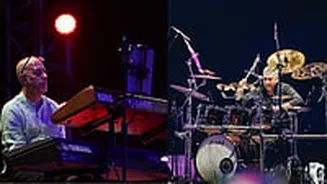

Last year robbed us of one of the greatest musicians this country has ever seen. Ustad Zakir Hussain, the legendary tabla virtuoso, was much more than a musician though. His long-term associates Ranjit
Barot and Zubin Balaporia believe that it was his humanity, his magnanimity and his positive approach towards life that drew everyone to him. The duo is paying a tribute to Hussain with a show titled ‘Ustad’ at the upcoming Serendipity Arts Festival happening in Goa. They have curated a line-up of incredible musicians such as Fazal Qureshi, Gino Banks, Rakesh Chaurasia and Louis Banks among others and the evening promises to be a musical extravaganza, right from jazz and fusion to Indian classical and contemporary improvisation. One of the highlights of the show is an audio presentation of the Ustad’s tabla performance. As Zubin puts it, “Though he will not be present physically with us on stage, he will be there sonically and spiritually.” They tell us more…
What kind of impact do you think Ustad Zakir Hussain had on music as well as on musicians?
Ranjit: More often than not, when people remember him, they remember his humanity even more than his music. He was someone who played the tabla and elevated that art form to such heights. He took the mantle from his father and was our cultural ambassador to the world and then became the glue that held the fabric of Indian classical music together. Even his seniors, like Shiv Kumar Sharmaji and Hariprasad Chaurasiaji and Amjad Ali Khan Sahib - although they were his seniors and he was very respectful of his place in the hierarchy - deferred to him. He was the shining light and I feel we've been robbed of our North Star.
I would think that young classical musicians today will find it hard to find a role model that they can fashion themselves after. The unique thing about Zakir Bhai was that nobody looked at him as a tabla player; they looked at him as a musician who was a master in many genres, whether he was playing with the Symphony Orchestra of India, or in a jazz ensemble with Charles Lloyd and Eric Harland, or his own trio with Bela Fleck and Edgar Meyer. Zakir Bhai is an ever-present force in everyone's life. We miss him, his humanity and his humour and we miss the challenges he’d throw our way. He would constantly ask us to up our game and was always looking out for everyone. Losing him means a lot of things.
How was your personal association with him?
Ranjit: He was my guru bhai. I studied with his father, who we lovingly called Abbaji. His father was even more of a saint - so giving and generous with his art form and his knowledge. I had no intentions of becoming a drummer but he knew I would be one before I even knew it! When it comes to Zakir Bhai, there is a mass hysteria that would happen. I don't know how many people really knew what his pursuit was and what he was trying to achieve in this lifetime and how he could be of benefit to music and musicians at large. I think that's an untold story.
Zubin: I knew him, of course and had met him as well but never played with him until I got a call from his manager in 2016, asking if I would like to do a concert with him and Niladri Kumar. It was a gift from heaven for me. After that, he started recording at my studio and the association grew so much stronger. I thought he was the most incredibly positive person on the planet. He was a joyous human being and was aware of the gift he had been given.
How did the two of you come together to pay this tribute to him?
Ranjit: The show is a prayer meeting for Zakir Bhai and the best way we can pray is through our music. Zubin and I have close ties with Serendipity Arts Festival, and I love what they do. We decided to collaborate, got in touch with a bunch of musicians who have performed with Zakir Bhai and here we are.