





Bhopal (Madhya Pradesh): In those vernal seasons of the year when the air is calm and pleasant, it was an injury and sullenness against nature not to go out and see her riches, and partake in her rejoicing
with heaven and earth – John Milton
The descending sun of a December Sunday afternoon was setting the western vault of the sky aglow.
The narrow Betwa River, a few metres away from the Bhopal-Vidisha highway, was blushing under the drooping sunlight. The hummocks were still visible in the falling daylight.
The sun slowly faded into the horizon, welcoming the twilight amid the twittering of birds returning to their nests. Evening shadows began to fall, consuming the trees and knolls. The Sunday crowd from nearby villages were returning to their homes, finishing their day’s business.
But for the glows from a few resorts and roadside food outlets, life on both sides of the highway was slipping into the oncoming darkness. At a few places, there were some vehicles.
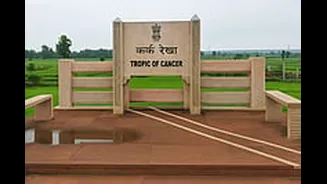
The place through which an imaginary line, the Tropic of Cancer, passes appeared before us under the street light. It is one of the MP’s most underrated treasures, which lies on the Sanchi-Bhopal Road.
When people reach the Tropic of Cancer, they find the area melting into the snaky stretches of serene countryside where life breathes in with different rhythms.
We slowed down the car to look at the cemented board, which proclaims the Tropic of Cancer passes here.
A selfie point has been set up in the area. It remains abuzz with activities in the morning, but in the pale moonlight, the place appeared quiet and dreamy, and it seemed as if life had stopped.
It may be an imaginary line, but when people look at the board, they feel it exists, and standing near it, they feel thrilled. They think as if they were touching a line that circled the earth.
Afar, a gentle breeze winnows the crops under the dim moonlight. Madhya Pradesh rarely boasts of its natural beauty, blessed with forests, mountains, waterfalls, and lakes.
This imaginary line of latitude, also called Kark Rekha (the Tropic of Cancer), is located at nearly 23.5 degrees north of the Earth’s equator.
It is significant, for this line marks the northernmost point where the sun rays fall overhead at noon. It passes through 14 districts of Madhya Pradesh, including Vidisha.
When the tourists pass by the Tropic of Cancer, they want to know who developed the idea of this line, which, despite being imaginary, is so important in geography and astronomy.
Though there is no single person behind advocating the idea of the Tropic of Cancer, ancient Indian texts, including the Mahabharata, mention the region of Jharkhand as Kark Khand, a place near the modern Tropic of Cancer because of its tropical forests.
The Mahabharata further speaks about the journey of the sun from the Tropic of Capricorn to the Tropic of Cancer as Uttarayan, or the northern course. In Hindu astrology, it is an important period, called Makar Sankranti. The ancient astronomers of Ujjain also said the Kark Rekha passes near Ujjain city.
The Periplus of the Erythraean Sea, written by an unknown Greek author and translated by an American antiquarian, Wilfred H. Schoff, also speaks about some places and a port, like Berenice, near the Tropic of Cancer.
Our car was moving towards Bhopal. Suddenly, a column of smoke, emerging from nearby farmlands because of stubble burning and from brick kilns, drew our attention. The column of black smoke, like a python, was wrapping its coils around the serene night, constricting it.