







The long-running weed infestation at Mumbai’s 210-hectare Powai Lake—home to legally protected crocodiles—has been found to be far more complex than water hyacinth alone, involving multiple invasive species,
ICAR has confirmed.
The lake assumes added significance as it is one of Mumbai’s major wetlands identified in the National Wetland Atlas published by the Union Ministry of Environment, Forest and Climate Change.
Responding to photographs and field inputs shared by environmental watchdog NatConnect Foundation, Dr Archana Anokhe, scientist at ICAR’s Directorate of Weed Research and Fellow of the Entomological Society of India, said the infestation appears to be multi-species in nature and cannot be addressed through routine mechanical removal alone.
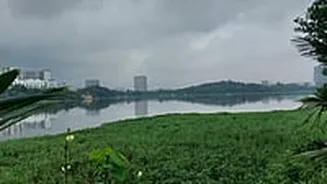
NatConnect director B N Kumar had earlier approached Dr J S Mishra, Director of ICAR’s Directorate of Weed Research in Jabalpur, seeking scientific intervention as the weed problem persisted despite repeated clean-up drives over the years. Dr Mishra asked Dr Anokhe to examine the issue, following which she reviewed images showing a dense green carpet choking large sections of the lake, the Foundation said in a press release on Tuesday.
Based on the visual assessment, Dr Anokhe—who is also a visiting scholar at Israel’s Agricultural Research Organisation—observed that the infestation “appears to involve a complex of invasive aquatic weeds, with Alternanthera suspected to be a dominant component, interspersed with water hyacinth in certain zones.” She cautioned that these observations are preliminary and limited by the absence of on-ground verification.
Dr Anokhe said such mixed infestations require species-specific, science-led interventions rather than uniform mechanical measures. ICAR said structured field trials are essential to identify effective management options and has expressed its willingness to visit Mumbai for on-site verification and studies, subject to logistical facilitation.
NatConnect has, therefore, formally requested the Brihanmumbai Municipal Corporation (BMC), to facilitate the proposed study in the larger public interest.
Kumar described it as “shameful” that an estimated 18 million litres of untreated sewage continues to flow into Powai Lake every day through 19 inlets, compounding the weed infestation. He said the nutrient-rich sewage acts as a continuous fertiliser for invasive plants, undermining clean-up efforts and explaining why repeated mechanical harvesting has failed to deliver lasting results.
To get details on exclusive and budget-friendly property deals in Mumbai & surrounding regions, do visit: https://budgetproperties.in/