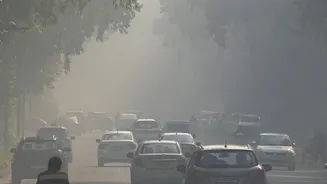

Delhi's air quality has worsened, slipping back into the 'Very Poor' category, with the Air Quality Index (AQI) exceeding 300 in many areas. Thick smog and fog trap pollutants, reducing visibility and disrupting
daily life.
Authorities are monitoring pollution levels and enforcing measures such as the 'No PUC, No Fuel' rule to address the situation.
Area-Wise AQI Readings
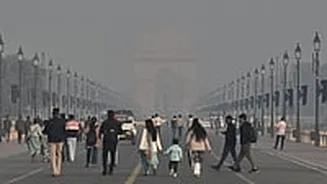
Visuals around India Gate as a layer of smog engulfs the national capital. The AQI (Air Quality Index) in the area is 303, classified as 'Very Poor' by the CPCB (Central Pollution Control Board).
Visuals around the Anand Vihar area as a layer of smog engulfs the national capital. The AQI (Air Quality Index) in the area is 410, classified as 'Severe' by the CPCB (Central Pollution Control Board).
Visuals around the ITO area as a layer of smog engulfs the national capital. The AQI (Air Quality Index) in the area is 379, classified as 'very poor' by the CPCB (Central Pollution Control Board).
In addition, visuals in the Akshardham area are affected as smog envelops the national capital. The AQI (Air Quality Index) in the area is 410, classified as 'Severe' by the CPCB (Central Pollution Control Board).
Visuals around the Dhaula Kuan area as a layer of smog engulfs the national capital. The AQI (Air Quality Index) in the area is 252, classified as 'Poor' by the CPCB (Central Pollution Control Board).
GRAP Stage III Measures Enforced
The Commission for Air Quality Management has invoked Stage III measures under the Graded Response Action Plan, including restrictions on construction and industrial activities.
A combination of cold weather, calm winds, and dense fog is trapping pollutants, leading to haze and smog. This cycle of poor air quality is expected to persist with current weather patterns, prompting continuous monitoring and calls for stricter pollution control measures.
'Very Poor' air quality requires people, especially vulnerable groups (children, elderly, those with respiratory issues), to limit prolonged outdoor exposure and wear masks.
Meanwhile, dense fog engulfed Karnal as cold wave intensified in the district.
Meanwhile, the national capital saw a sharp deterioration in air quality on Friday morning, with the overall Air Quality Index (AQI) at 305 around 8 am, placing it in the 'very poor' category, according to data from the Central Pollution Control Board (CPCB). Air quality declined sharply compared to Thursday, when the AQI was 234 at 4 pm. A thick layer of smog continued to blanket several parts of the city in the morning, further reducing visibility and overall air quality.
Health Advisory Issued
Earlier, the Delhi Cabinet, under the leadership of Chief Minister Rekha Gupta, approved a series of significant decisions to strengthen the capital's fight against pollution and improve environmental governance. The Cabinet approved an allocation of Rs. 100 crore for the rejuvenation of water bodies under the Delhi government. There are around 1,000 such water bodies in the national capital, of which 160 fall under the Delhi government's jurisdiction.
Sirsa stated, "The rejuvenation of Delhi's water bodies will play a crucial role in pollution control. The Chief Minister has directed that every possible financial support be extended to complete this work within the year."
The Cabinet also approved the establishment of Delhi's first E-Waste Park at Holambi Kalan, spread across 11.5 acres. The facility will adhere to the highest pollution-control standards and operate on a 100 per cent circular, zero-waste model.
"This will be India's first state-of-the-art e-waste facility built on zero pollution and zero wastage principles. The plant will fully recycle and reuse water through an advanced recirculation mechanism," Sirsa said.
(Except for the headline, this article has not been edited by FPJ's editorial team and is auto-generated from an agency feed.)