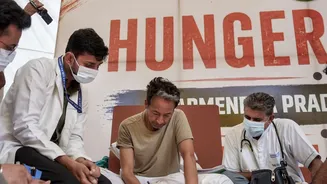
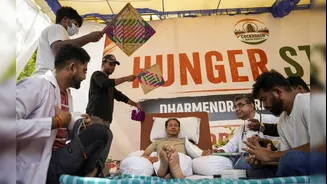
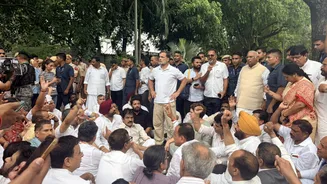
Like a tree bending violently in a tempest yet straining to keep its roots anchored, Union Education Minister Dharmendra Pradhan is braving the increasingly volatile NEET-UG paper leak protests demanding
his resignation.
Click here for CJP Jantar Mantar Protest LIVE updates
Yet Pradhan is hardly the first to face such heat. Many of his predecessors confronted equally intense, or even more severe, protests during their tenures.
In India, few ministerial portfolios hold as much volatile power as the Union Education Ministry, formerly the Ministry of Human Resource Development (HRD) until its renaming in 2020. This is because the ministry dictates the framework for national competitive entrance exams, university autonomy, reservation quotas and public school curricula. In short, its administrative decisions shape the daily realities and futures of over 300 million students.
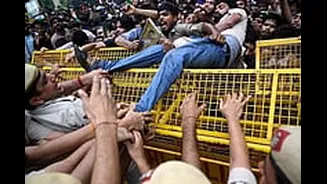
Whenever the ministry's policies seem to alienate student unions, faculty associations or marginalised communities, academic grievances swiftly spill beyond campus walls. The resulting standoffs have repeatedly turned cities, particularly the National Capital, into conflict zones marked by blockades, tear gas, water cannons, brutal lathi charges and tragic loss of human life. Dharmendra Pradhan Dharmendra Pradhan's tenure has witnessed some of the most widespread and sustained street volatility in recent Indian history following serious systemic failures surrounding national competitive examinations, specifically the NEET-UG paper leak case. Allegations of institutional corruption and commercial syndicates selling question papers have mobilised millions of desperate aspirants across the country. The unrest rapidly spilled out of coaching hubs and into the National Capital. Ramesh Pokhriyal's tenure (May 31, 2019, to July 7, 2021) was rocked by an unprecedented street siege triggered by a drastic hostel fee hike at Jawaharlal Nehru University (JNU) in late 2019, alongside regional fury over the language frameworks proposed in the National Education Policy (NEP) 2020. The unrest escalated into physical street violence between opposing political student unions, featuring mob clashes inside court premises, police crackdowns on campuses and global outcry, culminating in Irani being moved out of the portfolio in mid-2016. Kapil Sibal Kapil Sibal's aggressive push for structural reforms, specifically the introduction of the Four-Year Undergraduate Programme (FYUP) at Delhi University and sweeping changes to Class X and XII board examinations, ignited fierce street resistance between 2009 and 2014. The streets outside universities turned into battlegrounds between rival student unions armed with sticks and stones, attempting to enforce or break strikes. The political intensity was so severe that it triggered parallel street marches and high-stakes legal battles that eventually reached the Supreme Court.