







Move over Mumbai and Pune, because the real political heat for the January 15 municipal polls is being felt in Pimpri-Chinchwad, where Mahayuti allies -- the Bharatiya Janata Party (BJP) and the Nationalist
Congress Party (NCP) -- are at each other's throats, with neither willing to back down.
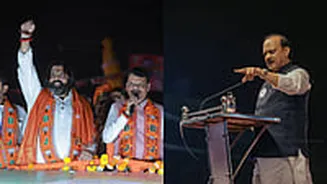
The NCP, which ruled the Pimpri-Chinchwad Municipal Corporation (PCMC) for nearly two decades, is making a determined bid to regain power from the BJP, which formed the civic body for the first time with a clear majority in 2017. Deputy Chief Minister Ajit Pawar is spearheading the campaign, alleging that the civic administration has witnessed immense corruption under the BJP rule and has been pushed into a debt-ridden state.
While refraining from directly attacking the BJP leadership, the Deputy CM is leaving no stone unturned in targeting the party's MLA Mahesh Landge, who represents the Bhosari Assembly constituency. Calling him the "leader of corruption" in the city, Pawar alleged that Landge has been "terrorising" people and "usurping" their land.
Taking the attack a step further, NCP-SP MLA Rohit Pawar likened Landge to Garuda, the villain from the movie 'KGF'. He alleged that the BJP MLA has taken cuts in everything, from small contracts to large ones.
Landge, in response, asked Ajit Pawar to introspect, particularly over the alleged Rs 70,000 crore irrigation scam and his son Parth Pawar's alleged role in the Mundhwa land deal case.
Chief Minister Devendra Fadnavis also entered the political slugfest, claiming that the quality of work carried out by the BJP during its tenure in the PCMC was far superior to the work done under the NCP's rule.
Interestingly, Landge, who began his career with the Congress, joined the NCP in the early 2000s and rose rapidly up the ranks with the backing of Ajit Pawar. When Landge expressed his desire to contest the 2014 Assembly elections, Pawar instead allotted the ticket to Vilas Lande, who had already won the seat twice. Refusing to step back, Landge rebelled, entered the fray as an independent candidate and emerged victorious. He later joined the BJP, a move that marked a turning point in his political journey. Since then, his rise has been sharp, earning him the moniker 'Hindutvawadi Aamdar'.
Why Is PCMC Important For BJP & NCP?
PCMC was once considered one of the richest civic bodies not just in India, but in Asia. The NCP is credited with much of the city's development. Its well-laid roads, flyovers, grade separators, and public gardens are said to be superior to those of its elder sibling, Pune. Its industrial zones, commercial hubs and planned infrastructure have made Pimpri-Chinchwad a model urban centre in the state.
The city's strategic location also adds to its importance. It is close to Mumbai, the financial capital; Pune, the cultural capital; Chakan, one of India's largest automobile manufacturing hubs; and Hinjawadi, the state's IT nerve centre.
For the NCP, regaining control is important to reclaim its lost political influence and restore its dominance in the region, while for the BJP, holding Pimpri-Chinchwad strengthens its foothold in western Maharashtra, complementing its existing strength in Pune City and giving it a strategic advantage for future state and national elections.
The Growth Story Of Pimpri-Chinchwad
After India's independence, the first major industrial unit to come up along the Pune-Mumbai highway was the Hindustan Antibiotics factory in Pimpri in 1955. It was established with the help of the World Health Organisation (WHO) and the United Nations Children’s Emergency Fund (UNICEF) to manufacture life-saving drugs like penicillin and amoxycillin. Later, the anti-venom unit of Haffkine Bio-pharmaceutical Ltd was shifted from Mumbai to Pimpri.
The real momentum came in the 1960s when Yashwantrao Chavan became Maharashtra's first CM and set up the Maharashtra Industrial Development Corporation (MIDC). With Mumbai becoming increasingly congested, many industrialists shifted their base to Pimpri-Chinchwad. Bajaj set up two-wheeler and three-wheeler manufacturing units, Tata Motors started their production of heavy commercial vehicles, and companies like Finolex followed soon.
Industries were offered attractive incentives, including developed industrial plots, with electric, water and road connectivity. This laid the foundation for rapid secondary growth. Tier-1, 2 and 3 suppliers mushroomed, transforming Pimpri-Chinchwad into a bustling industrial zone.
On the administrative side, in 1970, the villages of Pimpri, Chinchwad, Akurdi and Bhosari were brought under a single civic body, the Pimpri-Chinchwad Municipal Council (PCMC). In 1982, it was upgraded to a Municipal Corporation by incorporating more villages like Sangvi, Rahatani, Thergaon, Pimple Gurav, etc.
However, the city's growth accelerated dramatically after the construction of the Mumbai-Pune Expressway. Improved connectivity boosted real-estate demand, property prices soared, and large tracts of agricultural land were sold. Many landowners, known as "gaavwalas", amassed wealth and entered politics. Even today, the city's political dynamics continue to be greatly influenced by these "gaavwalas".