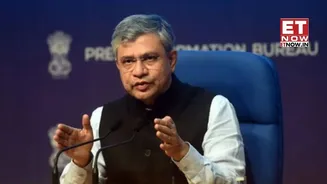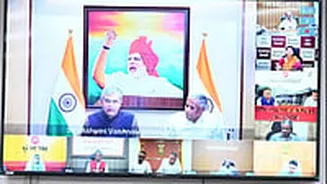

Ashwini Vasihnaw, MR and Sommanna MoSR addressed to media on Budget highlights of 2026-27 through video conference from New Delhi on February 2, 2026.
The main highlights are as under: -
Karnataka has witnessed
an unprecedented transformation in railway infrastructure, driven by a historic increase in budgetary allocation and sustained investment over the past decade. The average annual railway budget allocation for the state has risen sharply from ₹835 crore during 2009–14 to ₹7,748 crore in 2026–27 a nearly nine-fold increase to modernising rail transport in the state.
This enhanced funding has translated into large-scale infrastructure development, with railway works worth approximately ₹52,950 crore currently under progress across Karnataka. These works span new track creation, comprehensive station redevelopment, and major safety upgrades, ensuring balanced development across the entire state.
Under the Amrit Station Scheme, passenger experience is being redefined through modern, world-class station facilities. A total of 61 stations in Karnataka have been identified for complete redevelopment at an investment of ₹2,110 crore. Redevelopment works have already been completed at 5 stations—Bagalkot, Dharwad, Gadag, Gokak Road, Munirabad, and 4 stations are awaiting for inauguration are Badami, Alnavar, Koppal, and Bantawala delivering enhanced amenities, improved accessibility, and a modern travel environment for passengers.
Connectivity within and beyond the state has also seen a significant boost with the expansion of premium train services. Karnataka is currently served by 12 pairs of Vande Bharat Express trains and 3 pairs of Amrit Bharat Express trains, substantially improving travel speed, comfort, and efficiency.
Network expansion and electrification have progressed at a rapid pace. Since 2014, around 1,750 km of new railway tracks have been constructed in the state exceeding the total rail network length of Sri Lanka. Electrification has reached 97% of the network, with 3,368 km of rail lines electrified during the same period, supporting energy-efficient and environmentally sustainable operations. Additionally, 707 flyovers and underpasses have been constructed to enhance safety and ensure smoother road–rail connectivity.
In the area of rail safety, the advanced train collision avoidance system Kavach is being progressively implemented. Kavach works covering 132 route kilometres have already been deployed, works are in progress or under tender for about 1,500 route kilometres, and a total of 3,610 route kilometres have been sanctioned, marking a major step towards safer train operations.
Goa is also witnessing steady railway infrastructure growth under South Western Railway, supported by an average annual budget allocation of ₹515 crore in 2026–27. Infrastructure works worth ₹4,344 crore are currently under progress, focusing on capacity augmentation, station redevelopment, and safety improvements. Under the Amrit Station Scheme, three stations in Goa are being redeveloped at a cost of ₹65 crore. Passenger connectivity has been enhanced with two pairs of Vande Bharat Express services now operational. Since 2014, 24 km of new railway tracks have been constructed, 91% electrification has been achieved with 171 km commissioned, and 11 flyovers and underpasses have been built. Capacity enhancement is further being driven by the sanctioned Hospet–Vasco de Gama Doubling Project, covering 312 km at an estimated cost of ₹4,730 crore.
The video conferencing was chired by P. Ananth, Additional General Manager, South Western Railway, and also attended virtually by Ashutosh Kumar Singh, Divisional Railway Manager, Bengaluru; Smt. Bela Meena, Divisional Railway Manager, Hubballi; and Mudit Mittal, Divisional Railway Manager, Mysuru, and Principal Heads of Departments.