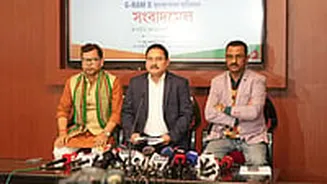

Guwahati: Amid opposition criticism over dropping Mahatma Gandhi’s name from the rural employment law, Assam BJP president Dilip Saikia on Wednesday said the debate should focus on what the new legislation
delivers on the ground rather than what it is called.
Addressing a press conference in Guwahati, Saikia said the newly passed Viksit Bharat Guarantee for Rozgar and Ajeevika Mission (Gramin) Bill, 2025 (VB-GRAMG) represents a major shift in rural policy, moving from what he described as a “relief-oriented” approach to a “development-oriented” one.
“The new Act is not just a renaming exercise. It is a structural upgrade of MGNREGA, designed to empower rural households and align employment with long-term development goals under the Viksit Bharat vision,” Saikia said.
Passed by Parliament in December 2025, the VB-GRAMG Bill formally replaces the Mahatma Gandhi National Rural Employment Guarantee Act. Under the new law, the statutory guarantee of wage employment has been increased from 100 days to 125 days per financial year for every rural household.
Saikia said the emphasis will now shift away from temporary works such as digging pits, toward creating durable assets like water conservation systems, rural roads, and other permanent infrastructure. In Assam, he said, rural works will be focused on four key domains, aimed at improving long-term productivity and resilience.
Highlighting what he called a significant gain for the Northeast, Saikia noted that Assam and other Himalayan states will continue to receive central funding under a 90:10 ratio, unlike the 60:40 pattern applicable to most other states. “This ensures the state is not financially overburdened despite the increase in guaranteed workdays,” he said.
The BJP leader also pointed to the introduction of the Viksit Bharat National Rural Infrastructure Stack, which will rely on biometric authentication, Aadhaar-linked payments, and geospatial tracking to ensure transparency. “This system will ensure wages reach the right people and that projects actually exist on the ground, eliminating middlemen and ghost beneficiaries,” he said.
According to Saikia, the new law also addresses long-standing issues under MGNREGA, including delayed payments and inefficiencies. VB-GRAMG mandates weekly or fortnightly wage payments and provides legally enforceable compensation for delays.
To address farm labour shortages, the Act allows state governments to suspend public works for up to 60 days during peak sowing or harvesting seasons. Planning, he added, will continue to be rooted in Gram Sabhas at the panchayat level, with digital integration across district, state, and national plans.
“MGNREGA had become stagnant over time,” Saikia said. “VB-GRAMG is designed to create quality assets, improve accountability, and make rural employment a true engine of growth rather than employment for employment’s sake.”
He maintained that the revamped framework would better serve rural India while aligning local development with national infrastructure priorities.