
Mumbai: For Indian students and young professionals, the India–European Union Free Trade Agreement is being presented not merely as a pact but as a gateway to classrooms, laboratories and careers across
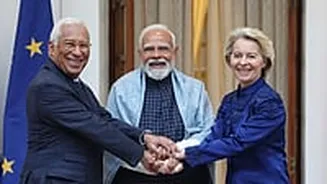
Europe. Announced at the 16th India–EU summit by Prime Minister Narendra Modi and European Commission President Ursula von der Leyen, the agreement places mobility, skills and knowledge exchange at the centre of a wider economic partnership.
Speaking after the conclusion of negotiations, the Prime Minister underlined the human dimension of the deal. “Alongside this ambitious FTA, we are also creating a new framework for mobility. This will open up new opportunities in the EU for Indian students, workers, and professionals. We have a long-standing and extensive cooperation in science and technology. Today, we have decided to further strengthen these important linkages,” Modi said.
The emphasis on education and professional movement marks a shift in how trade agreements are framed. Rather than focusing only on tariffs and market access, the India–EU pact links commerce with academic exchange, research cooperation and the global circulation of skilled labour.
Students and skills at the centre
Education services form part of the services commitments secured by India under the agreement. Indian service providers will gain predictable access to 144 subsectors in the EU, including education, professional services and information technology.
The framework also supports student mobility and post-study work opportunities, an issue of growing importance as Indian students look beyond traditional destinations. European universities already host tens of thousands of Indian students each year, but the new agreement aims to make movement easier and more structured. Officials say the pact strengthens cooperation between higher education institutions and promotes joint research, particularly in science and technology.
The agreement also includes commitments covering contractual service suppliers and independent professionals in sectors closely tied to education and training, such as research and development, computer services and professional consultancy. These provisions are designed to allow qualified Indians to provide services in EU member states under defined conditions.
A bridge between study and employment
For many Indian students, the biggest challenge after overseas education is transitioning from study to work. The mobility framework attempts to address this by creating clearer pathways for business travel, short-term assignments and intra-corporate transfers. Entry and working rights for dependants of intra-corporate transferees are also included, making long-term professional mobility more viable for families.
The agreement further establishes a platform for engagement on social security arrangements and post-study opportunities, giving graduates greater certainty about their future prospects. Union Commerce and Industry Minister Piyush Goyal described the pact as going far beyond a conventional trade deal. He said it represented “a comprehensive partnership with strategic dimensions” and would unlock “high-value commitments in services complemented by a comprehensive mobility framework enabling seamless movement of skilled Indian professionals”.
Linking education with emerging industries
The agreement highlights cooperation in future-facing sectors such as artificial intelligence, clean technologies and semiconductors. These areas are increasingly shaping university curricula and research priorities, and closer alignment with European institutions could influence how Indian education and training systems evolve.
For Indian universities and technical institutes, the pact offers opportunities to deepen collaboration with European counterparts in curriculum design, research programmes and student exchanges. In turn, European institutions gain access to one of the world’s largest pools of science and engineering students. This integration is expected to reinforce India’s ambition to become a global hub for innovation and knowledgebased industries, rather than remaining primarily a supplier of low-cost labour.
Economic context and opportunity
The EU is already among India’s largest trading partners. In 2024–25, bilateral trade in goods stood at $136.54 billion, while services trade reached $83.10 billion. Together, India and the EU account for about a quarter of global GDP and one third of world trade. Officials argue that integrating two large and diverse economies will generate new employment opportunities at home while opening European markets to Indian talent.
Labour-intensive export sectors such as textiles and engineering are expected to benefit, creating demand for skilled and semi-skilled workers trained in modern production and logistics. Agriculture and processed food sectors may also see gains, potentially strengthening rural livelihoods and encouraging greater emphasis on quality standards and agri-education.
Beyond commerce
The agreement also reinforces intellectual property protections while recognising India’s Traditional Knowledge Digital Library, signalling respect for indigenous knowledge systems alongside modern innovation. It includes provisions to address regulatory barriers and environmental standards, including cooperation under the EU’s carbon rules. For policymakers, this blend of trade, education and regulation reflects an attempt to align economic growth with sustainability and human capital development.
A generational shift
For young Indians, the significance of the India–EU FTA lies less in trade statistics and more in opportunity. Easier mobility, structured professional access and stronger academic cooperation promise to reshape how Indian students engage with Europe. By placing students and professionals at the heart of the agreement, the pact links classrooms to commerce and degrees to global careers. The goal is to strengthen “important linkages” in science, technology and mobility. If implemented effectively, the agreement could turn education into one of the most visible bridges between India and Europe, transforming a trade pact into a pathway for learning, work and long-term collaboration.