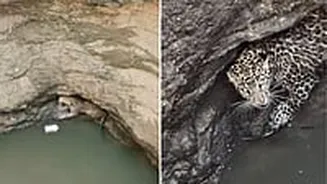









Indore (Madhya Pradesh): A three-year-old female leopard that fell into an open, parapet-lined well near Crescent Water Park in Gram Panchayat Jamnia Khurd was safely rescued on Saturday afternoon, reflecting
the effectiveness of Indore’s human–wildlife conflict management system.
Pradeep Mishra, IFS, Divisional Forest Officer (DFO), Indore, said that the Ralamandal Regional Rescue Team received information about the incident at around 12:30 pm and immediately rushed to the spot.
The rescue operation was carried out as per established protocols, and the animal was safely extracted from the well without injury.
“This rescue shows that human - wildlife conflict management in Indore is functioning as a well-organised and efficient system,” Mishra said.
He added that quick reporting by local residents and the readiness of trained teams played a key role in the successful outcome.
Mishra said that the rescued leopard is approximately 2 to 3 years old and has been shifted to the zoo for medical examination and observation.
He stated that the animal’s health evaluation is currently in progress and it remains under close monitoring.
“The leopard needs medical treatment before we could plan her release,” Mishra said.
Explaining the broader context, Mishra said that wildlife rescue operations in the Indore Forest Division have increased steadily over the last five years due to changing land-use patterns and greater overlap between human activity and wildlife movement.
Between 2021 and 2025, forest teams carried out 337 wildlife rescues, with a sharp rise recorded in 2024 and 2025.
“The rise in rescue numbers does not mean wildlife has become more aggressive,” Mishra said.
He explained that the trend reflects improved public awareness, faster reporting and increased trust in the Forest Department’s response system.
Mishra said that leopard rescues require special planning and caution because of the risks involved. Between 2021 and 2025, 66 leopard rescues were conducted in the division.
Most incidents occurred near villages, agricultural fields and urban edges, often linked to open wells, habitat fragmentation and wire snares laid for other animals.
“Many of the rescued leopards are cubs or sub-adults, which indicates natural dispersal rather than conflict-driven behaviour,” he said.
Mishra further said that the use of thermal drones, camera traps, rescue cages and coordination with police and local administration has helped ensure calm and safe operations.
He noted that most leopard rescues are preventive in nature, which has helped keep serious human injuries and fatalities low despite increasing wildlife presence.
Highlighting a recurring concern, Mishra said that open and unsecured wells continue to pose a major threat to wildlife such as leopards, nilgai and jackals.
He said that under the Integrated Human - Wildlife Coexistence Model (IHWCM), covering wells and spreading awareness are treated as essential conservation actions.