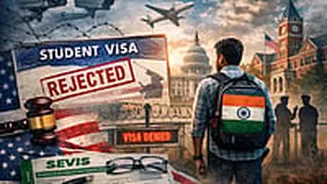

Mumbai: The United States has sharply tightened its approach to student visas, signalling a decisive shift towards tougher enforcement, wider scrutiny and reduced tolerance for violations. In a sweeping
crackdown framed around national security and immigration integrity, Washington has revoked tens of thousands of visas, including thousands held by international students, while Republican lawmakers push legislation to close what they describe as long-standing loopholes in the student visa system.
The US Department of State has confirmed that more than 100,000 visas were revoked as of 2025, with roughly 8,000 cancellations involving student visa holders. Officials said the actions followed criminal charges or breaches of visa conditions, ranging from overstaying and unauthorised employment to more serious offences such as assault, theft, drug-related crimes, drunk driving, child abuse and fraud. Nearly 500 student visas alone were revoked in cases linked to drug possession or distribution.
“This is more than double the number of visas revoked in 2024,” Principal Deputy Spokesperson Tommy Piggot said, underlining that enforcement had intensified markedly over the past year. While the bulk of revocations involved tourist and business visas, the inclusion of students and specialised workers has heightened anxiety among foreign nationals who once viewed US study routes as comparatively secure. The administration has been explicit that a visa can be withdrawn at any stage if a holder is deemed to pose a risk to public safety or national interests. That message, repeated by officials across departments, reflects a broader recalibration of immigration policy amid domestic political pressure and persistent security concerns tied to both legal and illegal migration.
Parallel to the enforcement drive, Republican lawmakers have moved to harden the statutory framework governing student visas. Congressman Brandon Gill of Texas has introduced the Student Visa Integrity Act, legislation aimed at overhauling how foreign students are vetted, monitored and retained within the US education system. Arguing that abuse has flourished under lax oversight, Gill said studying in the United States should be treated as “a privilege, not a right”.
Aim Of The Law
The proposed law seeks to impose fixed end dates on student visa programmes, expand mandatory in-person interviews, and restrict the ability of students to switch academic programmes once admitted. It also envisages severe penalties for universities or officials found complicit in visa fraud, including disqualification from federal student visa schemes. One of its most controversial provisions would bar students from countries deemed adversarial to the US and compel universities to disclose financial or institutional links with the Chinese government.
Supporters of the bill cite persistent weaknesses in the Student and Exchange Visitor Information System (SEVIS), the digital platform used to track international students. While foreign student enrolment has doubled from around 750,000 in 2012 to more than 1.5 million today, critics argue that monitoring tools have failed to keep pace with the scale and complexity of flows. Estimates suggest that as many as 50,000 individuals overstayed student or exchange visas in 2023, reinforcing calls for stricter controls.
On the ground, the impact is already being felt acutely, particularly in major sending countries such as India. Students report longer waiting times for interviews, higher refusal rates and a perceptibly harsher tone during consular interactions. An F-1 visa applicant from Hyderabad, admitted to a US university for a STEM programme, said delays had become routine. “The semester is about to begin, and many of us still don’t have interview slots,” the student wrote on an online forum. “Even strong profiles are being rejected. Consultants say this is the worst season in years.”
Others point to social media scrutiny as an emerging and decisive factor. A student from Pune, who applied for a short-term academic course, said his visa was refused despite what he believed was a robust application. “After the interview, they asked me to make my social media public,” he said. “Soon after, the visa was refused under Section 214(b). It feels as though online presence now carries significant weight.” The tightening is not confined to students alone. Skilled workers have also been drawn into the net, with the State Department, since December, subjecting H-1B and H-4 applicants to more stringent screening, including reviews of social media activity.
These measures have caused delays in visa processing across several countries, India among them, adding to uncertainty for employers and families alike. Taken together, the revocations, heightened scrutiny and proposed legislation point to a clear change in Washington’s posture towards student and skilled migration. The emphasis has shifted decisively towards monitoring, enforcement and deterrence, with little room for discretion or leniency.
Officials continue to stress that visas confer conditional access, not entitlement, and that the government will deploy all available tools to identify potential risks. For international students, the message is stark. The era of relative predictability is giving way to a far more exacting regime, in which compliance extends beyond classrooms to conduct, digital footprints and institutional affiliations. As the US rethinks its immigration framework, aspiring students will need to navigate a system that is not only more restrictive, but also markedly less forgiving.