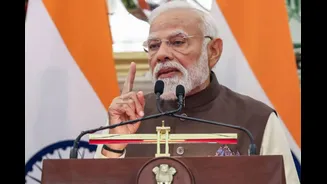

Prime Minister Narendra Modi’s address at the India Energy Week 2026 on Tuesday showcased India as a land of "immense opportunities" and a vital pillar of the global economy.
Highlighting the convergence
of nearly 125 nations in Goa, the prime minister detailed a strategic roadmap for India to transition from energy security to total energy independence.
With the backdrop of a historic trade deal with the European Union and massive infrastructure projects like the Samudra Manthan Mission, the address signalled India’s readiness to lead the world’s sustainable and secure energy future.
Here are 10 strategic takeaways from Prime Minister Modi's inaugural address at India Energy Week 2026:
-
Massive investment potential: The prime minister identified a staggering $500 billion worth of investment opportunities within India's evolving energy sector ecosystem.
-
The "Mother of all deals": Prime Minister Modi hailed the landmark India-EU Free Trade Agreement, representing 25 per cent of global GDP, as a game-changer for trade, democracy, and global supply chain resilience.
-
Refining powerhouse: India currently ranks second in global refining capacity (260 MMT) and is aggressively moving to become number one in the world by exceeding 300 MMT per annum.
-
Oil and gas expansion: India plans to attract $100 billion in investments to the oil and gas sector by 2030, expanding its exploration area to one million square kilometres
-
Samudra Manthan Mission: The government is prioritising deep-sea exploration with the Andaman and Nicobar basin emerging as a critical new frontier for hydrocarbon resources.
-
LNG infrastructure: To meet the target of a 15 per cent gas-based energy mix, India is building extensive LNG terminals, regasification units and a vast city gas distribution network.
-
Domestic shipbuilding: A new Rs70,000 crore shipbuilding programme has been launched to build indigenous LNG transport vessels, boosting the "Make in India" initiative.
-
Petrochemical growth: Rising domestic demand is driving a massive expansion in petrochemical infrastructure and downstream activities offering high returns for global investors.
-
The "reforms express": Prime Minister Modi emphasised that India is undergoing rapid, investor-friendly reforms, including reducing "No-Go" areas in exploration to maximise profitability for partners.
-
A global export hub: Already among the top five petroleum exporters to over 150 countries, India is positioning itself as a competitive provider of affordable refining and transportation solutions.