






What is the story about?

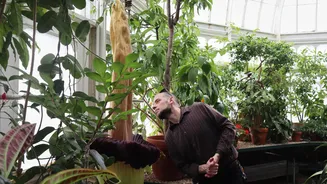
SOUTH HADLEY, Mass. (AP) — Visitors to Mount Holyoke College's Talcott Greenhouse experienced a range of reactions to the overwhelming odor of the blooming
corpse flower, described by some as reminiscent of rotting eggs or decaying flesh. Nyx DelPrado, a first-year student, remarked, “I was expecting it to smell bad, but it smelled genuinely like rotting flesh,” while others noted the smell was akin to a stinky diaper left in the sun.
The corpse flower, scientifically known as Amorphophallus titanum, is a rare tropical plant indigenous to the rainforests of Sumatra. It is infamous for its pungent odor, which serves to attract pollinators such as flies and beetles. Nicknamed 'Pangy,' this particular plant first bloomed at Mount Holyoke College in 2023, and its latest flowering has once again drawn crowds eager to witness and experience the unique spectacle.What appears to be a single bloom is actually a large inflorescence, consisting of many tiny flowers clustered around a tall central column known as the spadix, encased in a deep purple spathe. Although the impressive inflorescence wilts after a few days, the plant remains alive underground and is capable of blooming again in subsequent years.
Tom Clark, director and curator of the Mount Holyoke College Botanic Garden, explained that the plant's notorious scent serves a critical evolutionary function, eliciting a variety of descriptions from visitors. He stated, “A few people who have come in since have described the smell as being unbearable, tangy, like a trash can — it’s overwhelming. But that odor is there for a purpose. It’s there to attract pollinators, flies in particular.”
The blooming of the corpse flower is unpredictable, often occurring after extended periods of dormancy. Over the past six weeks, Pangy exhibited rapid growth, at times increasing several inches in a single day before finally blooming overnight on Monday. Clark and other staff members encountered the strong scent upon arriving at work the following day.
“Walking through the front door, we could smell it,” Clark recounted. “As we walked back to the greenhouse where it’s growing, the smell became stronger and stronger. It was just overwhelming — literally unbearable — to be back there with it. If you weren’t aware of this plant and walked into the greenhouse, you’d say, ‘What died in here?’”
The event attracted visitors from various locations, including Michael Breton, who traveled two hours and took a vacation day to see the bloom after following news alerts for years. Breton compared the odor to “a stinky diaper that’s been left out in the sun,” but he also appreciated the plant's vibrant appearance, describing it as “bright, beautiful and colorful. It’s a lovely plant.”
Others found the smell more familiar than off-putting. Caroline Murray, a senior, noted, “I would say it smells kind of like a compost pile, a little bit like a working farm,” reflecting her experiences growing up in Vermont.
Clark emphasized that the bloom underscores the broader mission of the Talcott Greenhouse, which he referred to as a 'plant museum' housing approximately 2,000 species, representing a small fraction of the estimated 350,000 to 400,000 plant species worldwide. He stated, “When anyone comes to the greenhouse, it’s an opportunity to engage them with some facet of the plant world. When it’s a plant that’s so dramatic as the corpse flower, it’s this special opportunity to impress upon them the diversity and some of the amazing adaptations that plants have to survive in their environment in unique ways.”
By midday Tuesday, the odor began to dissipate as greenhouse vents were opened, providing visitors with a less intense, yet still memorable experience. Following the brief flowering period, the plant will gradually deteriorate and collapse. Since corpse flowers cannot self-pollinate, seeds will only form if pollen from another titan arum is present.
For Namuuna Negi, a junior, the ephemeral nature of the bloom heightened the experience. “The impermanence of it, I think. People like to be in on what’s happening,” she observed. “If they hear something’s going to die soon, they want to go see it before that happens so they can talk about it later.”