





What is the story about?

U.S. President Donald Trump departed Beijing on Friday following a final meeting with Chinese President Xi Jinping. The leaders said they made progress
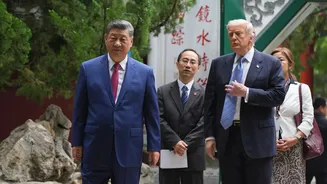
in stabilizing U.S.-China relations, but deep differences remained after two days of meetings and meals. On Friday, they walked the grounds of Zhongnanhai, Xi's official residence, and had a working tea and lunch. During a series of meetings and events Thursday, the two discussed divisive issues such as the Iran war, trade, technology, and Taiwan.
China has shown little public interest in getting more involved in solving the war in Iran. Xi also suggested differences over Taiwan could put his country and the U.S. on the path toward conflict. Threats of each side imposing steep tariffs also still loom.Trump said Xi told him China wants to help negotiate an end to the war and a reopening of the Strait of Hormuz. China is the largest buyer of Iranian oil, and Trump hopes Xi will use that leverage to prod Iran into a deal on U.S. terms. Trump also said Xi assured him that China wouldn’t provide Iran with military equipment.
Trump has taken a decidedly rosy outlook on the U.S.-China relationship during this trip. But that has collided with some difficult truths about the thorniest issues between the two superpowers including Taiwan, the Iran war, and trade.
In a summit marked by fanfare and flattery, Xi warned Trump that differences over Taiwan, a self-governed island claimed by Beijing as its own territory, could bring the U.S. and China into clashes or conflict. Trump authorized an $11 billion arms package for Taiwan in December, but has not moved forward with delivery. Secretary of State Marco Rubio warned later on Thursday it would be “a terrible mistake” for China to take Taiwan by force.
Trump also focused on trade and deals for China to buy more agricultural products and passenger planes, setting up a board to address their differences and avoid a repeat of the trade war ignited last year after Trump’s tariff hikes.
Jensen Huang, CEO of Nvidia, took a food tour of Beijing during the summit, sampling local delicacies including a bowl of “zhiangmian,” a specialty noodle dish. He expressed his enjoyment of the dish but winced at the taste of “douzhi’er,” a fermented soybean drink, leading to trending videos of his reaction.
China said the two leaders agreed to a new vision for dealing with their relationship issues: “a constructive China-U.S. relationship of strategic stability.” The Chinese Foreign Ministry stated that this framework would shape ties for at least three years and focus on cooperation, competition within proper limits, and managing differences.
Schoolchildren dressed in Air Force One’s light blue and white colors waved American and Chinese flags in a coordinated movement as Trump arrived to board the plane. Chinese Foreign Minister Wang Yi saw a smiling Trump off at the airport, where he waved before entering the aircraft.
During their two days together, Trump and Xi spent significant time discussing issues at the Great Hall of the People, touring the Temple of Heaven, and attending a banquet. Xi suggested that differences over Taiwan could lead to conflict, while the threat of steep tariffs from both sides looms large.
While little has been announced about any potential deals during a closed-door lunch in Zhongnanhai, Xi characterized the visit as historic, affirming a constructive, strategic, and stable China-U.S. relationship. He emphasized the importance of maintaining mutual understanding and deepening trust between the two nations.
Trump and Xi enjoyed a formal lunch that included a menu featuring minced codfish in seafood soup, crispy lobster balls, and pan-seared beef fillet. The meal concluded with desserts including chocolate brownies and fruits.
Before their closed-door lunch, Xi gave Trump a tour of Zhongnanhai, highlighting centuries-old trees in the gardens. Trump admired the beauty of the grounds, noting the age of the trees Xi pointed out.
As Trump dined on an elaborate meal inside, members of the U.S. Embassy and White House staff outside enjoyed McDonald's, a favored choice of the president. The juxtaposition drew attention as the press pool awaited Trump's departure.
During the summit, Trump refrained from taking questions from reporters, a notable deviation from his usual practice. His relative silence extended to his social media activity, where he was less active than usual.
While the White House has not released specific details of any deals struck during the summit, Trump expressed optimism about the outcomes, referring to “fantastic trade deals” that could benefit both countries. He indicated that discussions included significant topics like the Iran war and the Strait of Hormuz.
China reiterated its call for a diplomatic solution to the Iran war, emphasizing the need to reopen shipping routes in the Strait of Hormuz. The Chinese Ministry of Foreign Affairs highlighted the importance of dialogue in resolving tensions.
A spokesperson for the Chinese Foreign Ministry stated that Trump's meetings with Xi have advanced cooperation and injected stability into the global landscape. The two leaders agreed to strengthen communication and coordination on international and regional issues, focusing on managing differences and limiting competition.
Trump concluded his visit to China, emphasizing the need for loyalty among the Indian diaspora in the U.S. and urging them to contribute positively to their new home. He expressed a desire for a strong relationship between the U.S. and India, citing the benefits of cultural exchange.