







What is the story about?

President Donald Trump's White House ballroom received final approval from a key agency on Thursday, despite a recent federal judge's order to halt construction
unless Congress permits significant structural changes to the historic site. The National Capital Planning Commission, tasked with overseeing federal property construction in the Washington area, voted on the project following U.S. District Judge Richard Leon's ruling, which affects construction but not the planning process, according to the commission's chair, Will Scharf.
The commission voted 8-1 to advance the ballroom project, with two commissioners voting present and one absent. Although the approval allows planning to continue, legal challenges stemming from the judge's ruling may delay progress on a project that Trump aims to complete by early 2029.Before the vote, Scharf, who is closely aligned with the Trump administration, indicated that the judge's order would not impede their actions, as it has been stayed for two weeks while the administration pursues an appeal. He passionately defended the ballroom's significance, recalling past White House modifications that faced criticism but later gained public appreciation.
Scharf suggested that the proposed ballroom would similarly be recognized as a valuable addition to the White House, despite some public and governmental opposition. He stated, “In time this ballroom will be considered every bit as much of a national treasure as the other key components of the White House.”
He further argued that the negative perceptions surrounding the project stem from opposition to Trump rather than the project's merits, asserting, “We’ve been unfairly slighted in the press and otherwise for the way we’ve gone about reviewing this particular project.”
The commission's vote was initially scheduled for March but was postponed due to extensive public comment, which predominantly opposed the ballroom. The sole dissenting vote came from Phil Mendelson, a Democrat and chair of the Council of the District of Columbia, who criticized the ballroom's design and the speed of its approval.
Mendelson expressed his concerns, stating, “It’s just too large.” Public Citizen, a consumer advocacy group, echoed this sentiment, with attorney Jon Golinger calling the commission's approval “illegitimate” and dismissive of the public's opposition.
In a statement following the vote, Trump expressed gratitude to the commissioners, proclaiming the ballroom would be “the Greatest and Most Beautiful Ballroom of its kind anywhere in the World.”
Prior to the vote, the commission considered design changes to the ballroom, which the president announced while traveling on Air Force One. Changes included removing a large staircase and adding an uncovered porch. Critics had deemed the staircase excessive and impractical.
A White House official noted that the president had taken into account feedback from the National Capital Planning Commission and the U.S. Commission of Fine Arts, which had previously approved the project. The ballroom's estimated cost has risen to $400 million, reflecting its expanded scope since the initial announcement last summer.
Two other Trump-appointed commissioners supported the project, emphasizing the White House's current limitations in hosting large events. Vice Chairman Stuart Levenbach stated that the addition would enhance the overall utility of the compound, which will include not only the ballroom but also offices for the first lady and additional facilities.
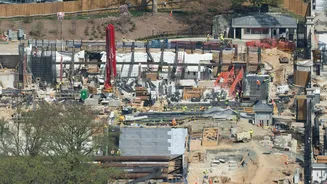
Despite the approval, the National Trust for Historic Preservation has filed a lawsuit concerning the demolition of the East Wing to accommodate the ballroom, which is nearly twice the size of the mansion itself. Trump has asserted that funding will come from private donations, although public funds are being allocated for security upgrades.
Judge Leon's ruling allows for a temporary halt to construction until the project is presented for approval to both oversight commissions and Congress. His order, however, permits construction related to security enhancements.