







What is the story about?

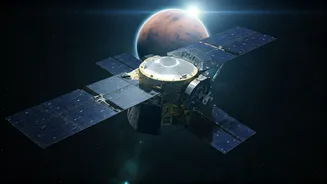
CAPE CANAVERAL, Fla. (AP) — A NASA spacecraft chasing a rare metal asteroid swings past Mars this week for a gravity boost, snapping thousands of pictures
as practice for the main encounter in 2029. Named Psyche like the asteroid it’s after, the robotic explorer will slingshot past the red planet at 12,333 mph (19,848 kph) on Friday.
This flyby will be particularly close, with Psyche passing within 2,800 miles (4,500 kilometers) of Mars, which is roughly the distance between the U.S. east and west coasts. Following this maneuver, the spacecraft will head toward the asteroid belt situated between Mars and Jupiter, where its intriguing target resides.During the Mars pass, all of the spacecraft’s science instruments will be operational. NASA’s two Mars rovers, along with a small fleet of U.S. and European orbiters, will simultaneously conduct surface and atmospheric observations to facilitate comparative studies.
Psyche's cameras are already capturing images of Mars, initially appearing as a crescent and later as a nearly full sphere once it is out of view. These varied perspectives will not only assist operators in fine-tuning their instruments but will also provide aesthetically pleasing photographs, according to Jim Bell, the imaging team leader at Arizona State University.
Although the asteroid belt is populated with millions of objects, the majority consist of rock or ice. A small fraction is believed to be metal-rich like Psyche, which is a potato-shaped asteroid measuring approximately 173 miles long and 144 miles wide (278 kilometers by 232 kilometers).
Scientists hypothesize that the asteroid may represent the exposed nickel and iron core of a nascent planet that was stripped down by cosmic collisions. Investigating such an object closely could yield insights into the early formation of our solar system, which occurred around 4.6 billion years ago, as well as the conditions that allowed Earth to support life.
Launched in 2023, the spacecraft is currently on a six-year journey to Psyche, located in the outer edges of the asteroid belt, three times farther from the sun than Earth. It is scheduled to arrive in 2029, at which point it will enter orbit around the asteroid for two years of study. The van-sized spacecraft utilizes solar electric propulsion, powered by xenon gas thrusters.
___
The Associated Press Health and Science Department receives support from the Howard Hughes Medical Institute’s Department of Science Education and the Robert Wood Johnson Foundation. The AP is solely responsible for all content.