






What is the story about?

MANILA, Philippines (AP) — An offshore magnitude 7.8 earthquake rocked the southern Philippines Monday, leaving at least 12 people dead, injuring more
than 200 others mostly in damaged buildings, and sparking a 1-meter (3-foot) tsunami along nearby coasts, officials said. The Pacific Tsunami Warning Center reported that the threat of a tsunami had largely passed about five hours after the quake struck the southern region of Mindanao. Teresito Bacolcol, director of the Philippine Institute of Volcanology and Seismology, stated there have been no reports of damage or casualties from the tsunami.
“It’s a major earthquake and we’re expecting damage and we’ve already seen some damaged buildings based on videos we’ve received,” Bacolcol told The Associated Press.The strongest quake to strike the Philippines this year was centered at sea at a depth of 33 kilometers (20 miles), about 32 kilometers (20 miles) southwest of Maasim town in Sarangani province, according to the Philippine institute.
General Santos, a southern port city of more than 700,000 people that serves as a hub for the tuna export industry and other commerce, was among the hardest hit.
Philippine President Ferdinand Marcos Jr. assured that "the national government is moving and we will not leave Mindanao behind.”
Numerous aftershocks followed the 7:37 a.m. quake, which was also felt in Malaysia. Smaller tsunami waves were detected in Indonesia and Malaysia.
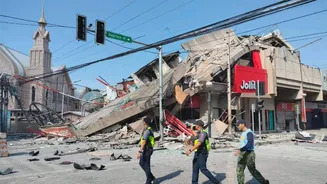
At least seven people were killed and about 130 others injured in General Santos, where a few small buildings partially collapsed, and several structures, including a key access bridge, sustained dangerous cracks, Rod Sosmeña, regional director of the Office of Civil Defense, informed The AP.
Five additional fatalities occurred in the southern provinces of South Cotabato and Davao Occidental, as well as on Balut Island, according to Sosmeña and another official, Ednar Dayanghirang.
Sosmeña mentioned that authorities were checking reports of students being trapped in a two-story school that collapsed in General Santos. While he could not provide immediate details, the national police reported that at least seven people were missing in the city.
Public schools had reopened nationwide Monday after the summer break. Dayanghirang noted that more than 100 students attending morning flag-raising ceremonies sustained bruises and some fainted in panic.
The international airport in General Santos was temporarily shut down, resulting in the cancellation of 17 domestic flights, according to civil aviation officials.
“Our pickup truck suddenly jerked and I thought we had a flat tire,” Sosmeña recounted. “People dashed out of houses into the streets.”
Dayanghirang described his experience, stating, “I could hardly stand and keep my balance when the ground shook as I was leaving my house” in the southern port city of Davao.
DZRH radio in Manila reported that a small commercial building housing its provincial station partly collapsed, with staffers rushing to the ground floor without injuries. It remained unclear if others were trapped in the rubble of the four-story office building. Debris also fell from other buildings, hitting tricycle taxis parked below.
Waves of 1 meter (3 feet) were recorded in the provinces of Sultan Kudarat and Sarangani.
Malaysia’s Meteorological Department issued a tsunami warning for Sabah state on Borneo island, which is just a boat ride away from southern Philippines. An 83-centimeter (2.7-feet) tsunami was measured by a gauge off Indonesia's Sulawesi island.
The U.S. Geological Survey reported the depth of the original quake at 55 kilometers (34 miles). Variations in measurements by different agencies are common in the immediate aftermath of an earthquake.
The Philippines, one of the world’s most disaster-prone countries, frequently experiences earthquakes and volcanic eruptions due to its location on the Pacific “Ring of Fire,” an arc of seismic faults around the ocean. The archipelago also faces approximately 20 typhoons and tropical storms each year.