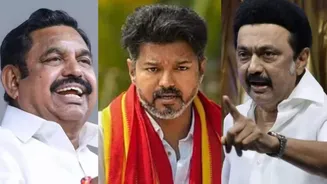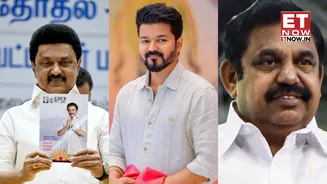






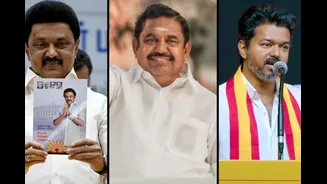

When Tamil Nadu voters walk into polling booths on April 23, they will be choosing between more than just leaders. They will be endorsing competing economic
philosophies — each with a distinct answer to the same pressing question: how does a state of 80 million people create enough good work for its young? The 2026 assembly election has broken from the familiar mould. For decades, Tamil Nadu politics ran on a reliable alternating current between the Dravida Munnetra Kazhagam and the All India Anna Dravida Munnetra Kazhagam. This cycle, actor-turned-politician Vijay's Tamilaga Vettri Kazhagam has stepped in as a third force, drawing enough youth interest to disturb settled calculations across the 234-seat assembly. The manifestos released by all three parties tell this story in economic terms. Each document is pitched at a state whose IT exports crossed ₹3 lakh crore, yet where graduate unemployment and workforce informality persist as stubborn realities.
The Incumbent's Gamble: Deeptech and State Ambition
Chief Minister MK Stalin's DMK enters this election with a record to defend and an ambitious horizon to sell. Its manifesto is arguably the most technology-forward document in Tamil Nadu's electoral history — a deliberate attempt to anchor the party's identity in innovation rather than welfare alone.
The centrepiece is a commitment to building 100 deeptech startups by 2030, supported by dedicated innovation labs and strengthened intellectual property frameworks. More symbolically, the DMK has promised to develop a Tamil Large Language Model and launch a Tamil-AI Fellowship — positioning the state not just as a consumer of artificial intelligence, but as a contributor to its development.
These are not small ideas. But they carry proportionally large questions. Building competitive language models demands sustained compute infrastructure, curated datasets, and multi-year funding commitments. The manifesto is largely silent on the financing architecture behind these proposals.
The party also points toward quantum computing, citing state-funded simulators as a foundation. Given that India's national quantum mission is itself still in early stages, a state-level push without deep industry anchoring will need more than policy enthusiasm to produce tangible employment.
On jobs, the DMK has committed to 50 lakh new positions over five years, channelled through industrial parks, food processing corridors, and expanded skilling. Its 'Naan Mudhalvan 2.0' scheme extends the existing programme with a ₹1,500 monthly stipend. Private firms hiring candidates from disadvantaged backgrounds would receive incentives — a signal that inclusion has been written into the employment strategy, not treated as an afterthought.
The manifesto is visionary. It is also heavily reliant on state machinery to deliver. In a government known for large announcements, the distance between intention and implementation will define this agenda far more than the words on the page.
The Opposition's Calculation: Ground-Up Industrialisation
The AIADMK, which governed Tamil Nadu for a decade before losing in 2021, has built its 2026 manifesto around a simpler proposition: that growth begins not in technology parks but in the districts, in small enterprises, and in the everyday economy.
Its headline commitment — creating one lakh micro and small enterprises over five years — is calibrated for breadth rather than depth. The party is betting that decentralised industrialisation, built on the model of Tamil Nadu's existing manufacturing base, can absorb more workers more quickly than deeptech ambitions.
Collateral-free loans of up to ₹25 lakh for young entrepreneurs form part of this pitch. Combined with proposals for a Skill Development University and the integration of AI into school and college curricula, the AIADMK is trying to hold together two audiences: first-generation entrepreneurs in smaller towns and urban youth who see technology as their ladder.
The most debated element of the AIADMK's economic platform is its promise to reserve 75 percent of private sector jobs for Tamil Nadu residents. The proposal has electoral appeal in constituencies where migrants are seen as competing for limited work. But the legal landscape is hostile — similar reservation mandates in Haryana and Andhra Pradesh have run into sustained judicial challenge — and industry groups have warned that such requirements complicate hiring decisions for companies evaluating expansion.
The party has also proposed restructuring school curricula to introduce computer science as a sixth subject for classes 6 through 10, alongside existing core subjects. It is a relatively modest intervention, but one whose effects, if sustained, could be more durable than any single scholarship programme.
The AIADMK's manifesto reads like a document written by people who have governed before. It is cautious where the DMK is expansive, familiar where TVK is experimental. Whether that is reassuring or uninspiring may depend on which Tamil Nadu the voter lives in.
The Challenger's Pitch: Money Now, Opportunities Later
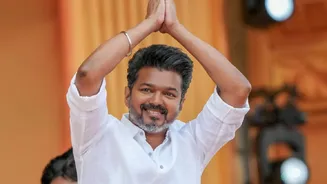
TVK is fighting its first full general election with a manifesto structured around directness. Where the DMK offers ecosystems and the AIADMK offers enterprise, Vijay's party offers cash — and makes no apology for it.
The numbers are specific and substantial. Unemployed graduates would receive Rs 4,000 per month. Diploma and ITI holders would receive ₹2,500. Internship schemes would place five lakh youth annually with private companies, with the state paying ₹10,000 per month for graduates and Rs 8,000 for diploma holders during training.
The aggregate fiscal burden of these commitments is significant, and TVK's manifesto does not yet offer a detailed revenue map to match its spending promises. This is the sharpest vulnerability in an otherwise coherent document.
Where TVK breaks new ground is in its "Creator Schools" proposal — a network of 500 institutions across the state designed to develop skills in content creation, digital media, and new economy professions. In a state with high smartphone penetration and a youth population that has already built substantial online audiences, the idea has real-world grounding. It is also the kind of policy that neither the DMK nor the AIADMK has imagined at scale.
TVK mirrors the other parties on women's economic empowerment, promising to convert self-help groups into registered MSMEs with annual financial support, and offering loan guarantees of up to ₹25 lakh for new entrepreneurs.
What the manifesto lacks is a technology or industrial strategy of comparable depth. Immediate relief for unemployed graduates is a legitimate policy goal. But without a parallel vision for job-creating investment, TVK's platform risks addressing a symptom more effectively than the underlying condition.
The One Issue All Three Agree On
Beneath the disagreements on welfare, industrialisation, and job reservation lies a notable point of consensus: all three parties treat artificial intelligence as central to Tamil Nadu's future.
The DMK wants to build AI. The AIADMK wants to teach it in schools. TVK wants to embed it in a new generation of creator-entrepreneurs. The framing differs, but the underlying conviction is shared — that a state which does not orient its workforce toward AI will cede economic ground in the decade ahead.
This convergence is itself significant. It reflects a political reading of public sentiment: that Tamil Nadu's electorate, especially its younger cohort, expects parties to engage seriously with technology rather than treat it as a footnote to traditional welfare politics.
What the Election Will Actually Decide
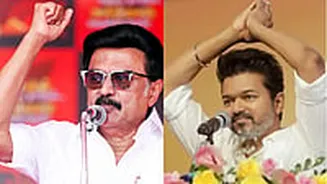
Tamil Nadu's election is not yet decided by manifestos. Alliances, caste arithmetic, local grievances, and candidate selection will shape the result as much as any policy document. The DMK's alignment with Congress and the Left, the AIADMK's expected proximity to the BJP, and TVK's attempt to build a cross-community coalition each carry their own regional dynamics.
But the 2026 contest has produced something less common in Indian state elections: a genuine three-way argument about what kind of economy voters want to live in.
One party is betting on the state's capacity to build the future. Another is betting on the districts' capacity to industrialise it. A third is betting on the young generation's impatience to begin.
On April 23, Tamil Nadu will choose which bet it finds most credible.