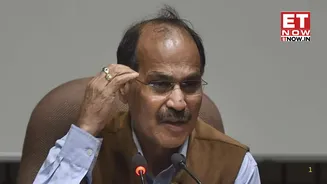








There is something almost theatrical about Adhir Ranjan Chowdhury choosing Berhampore Assembly constituency as the stage for his political rehabilitation.
The man who represented the Baharampur Lok Sabha seat five consecutive times — making him the most dominant Congress figure in Bengal for the better part of two decades — was humiliated on this same ground in 2024, losing to cricketer-turned-politician Yusuf Pathan of the Trinamool Congress by more than 85,000 votes. He resigned as West Bengal Congress president immediately after, accepting personal responsibility for the party's collapse in the state. Now he is back. Not to Parliament, where he built his reputation, but to the assembly, which he has not contested in 25 years. The decision is either a calculated political repositioning or a man refusing to accept that his story in this district is over. Possibly both. What is certain is that his return has transformed Berhampore from a moderately interesting constituency into the most closely watched seat in Bengal's April 23 first-phase polling.
The Seat and Its History
Berhampore is not just politically significant — it carries history in its soil. The town was established in 1757 in the immediate aftermath of the Battle of Plassey, becoming one of the earliest administrative and military bases the East India Company established in India. Dutch, French, and British traders followed, turning it into a commercial hub that sat at the intersection of colonial power and regional commerce.
That layered history has produced a constituency with a particular political character — urban enough to have a municipal centre in Berhampore town, rural enough to include five gram panchayats spread across Bhakuri I, Daulatabad, Gurudaspur, Hatinagar, and Manindranagar. Two of those panchayats are Muslim-majority, but the constituency's overall electorate is predominantly Hindu at nearly 70 per cent — a demographic reality that effectively determines the winner and gives religious polarisation a structural role in this election that no candidate can fully ignore.
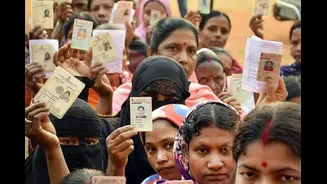
The registered voter base stands at 2,60,667 — comprising 1,28,101 male voters, 1,32,553 female voters, and 13 voters from the third gender category, according to Election Commission data from 2021.
Three Candidates, Three Very Different Stories
Adhir Ranjan Chowdhury — Congress
Chowdhury arrives at this contest carrying the weight of the 2024 Lok Sabha defeat and the complicated reputation of a politician who was once untouchable in Murshidabad and is now fighting to prove he still belongs here. His case to the voter is essentially one of continuity and credibility — that his decades of work in this district count for something that a single election result cannot erase.
The challenge he faces is not just electoral arithmetic. It is the question of whether the Congress support base in Berhampore, which has been eroding steadily since the TMC's rise and was further damaged by the 2021 result where the Congress candidate finished third, has enough residual loyalty to deliver him a victory. He is asking voters who abandoned Congress at the parliamentary level to come back for him at the assembly level — a difficult argument that requires them to separate their feelings about the party from their feelings about the man.
Subrata Maitra — BJP
Maitra is the sitting MLA and the first BJP legislator this constituency has ever sent to the assembly, which makes his 2021 victory both a personal achievement and a historical landmark for his party. He beat TMC's Naru Gopal Mukherjee by nearly 27,000 votes and pushed the Congress candidate to a distant third — a result that looked decisive at the time and looks rather more complicated now that Chowdhury has entered the picture.
His campaign strategy reflects what won him the seat the first time. Rather than large public rallies and the infrastructure of a big-ticket political event, Maitra does door-to-door, 500 households a day, by his own count, building personal relationships in a constituency small enough that this kind of retail politics can move numbers. Against a heavyweight like Chowdhury, whose brand is built on public profile and parliamentary visibility, the contrast in approach is itself a message: the man who knows your name versus the man who knows the television cameras.
The backdrop of the 2025 Murshidabad communal violence and the BJP's sustained campaign around demographic change in border districts gives Maitra an ideological context that consolidates the party's core Hindu vote. Whether it expands that vote beyond 2021 levels is the question his campaign is built around answering.
Naru Gopal Mukherjee — TMC
Mukherjee has been here before — literally. He lost to Maitra in 2021 by nearly 27,000 votes and has spent the intervening years as the TMC's face in this constituency. His position in 2026 is complicated by the entry of Chowdhury, whose presence draws from a Congress base that in a straight TMC-BJP fight might have drifted toward the Trinamool.
But Mukherjee also represents the possibility of triangular mathematics working in TMC's favour. If Chowdhury and Maitra split the Hindu vote between Congress loyalists and BJP supporters, the TMC's consolidated base — particularly strong in the Muslim-majority panchayats and among communities with long TMC affiliations — could carry Mukherjee through the middle. It is the kind of quiet arithmetic that does not make for dramatic campaign speeches but has decided more Indian elections than any of the other factors that receive more attention.
What the 2021 Result Actually Tells You
The 2021 numbers in Berhampore are worth examining carefully because they set the baseline for what 2026 might produce. Maitra won with a margin of approximately 27,000 votes over Mukherjee. The Congress candidate Manoj Chakraborty finished third with 40,167 votes.
That third-place Congress vote is the most important number in this election. It represents a base of Congress supporters who stayed loyal to the party even when it was a distant third — voters who did not switch to either the BJP or TMC despite having every electoral incentive to do so. With Chowdhury now carrying the Congress ticket instead of a relatively unknown local candidate, the question is whether those 40,000-plus voters stay with Congress and whether additional voters who had drifted away return for Chowdhury personally.
If the Congress vote consolidates and grows under Chowdhury's name recognition, he has a path. If it stays roughly where it was in 2021, he finishes third again and the 2024 humiliation has a sequel.
The Murshidabad Factor
Berhampore sits in Murshidabad district, and Murshidabad carries specific political weight in the 2026 Bengal election. The 2025 communal violence in the district — which the BJP has made a central campaign issue statewide — has sharpened the polarisation along religious lines that was already present in border constituencies with significant Muslim populations.
For Maitra and the BJP, Murshidabad's recent history is a campaign asset — evidence, in their framing, of what unchecked demographic change and weak law enforcement produce, and a reason for Hindu voters to consolidate behind the party most vocally committed to addressing it. For Chowdhury and the Congress, navigating that narrative requires walking a careful line between acknowledging genuine security concerns and avoiding the kind of communal framing that alienates the Muslim voters whose support Congress has historically relied upon in this constituency.
For Mukherjee and the TMC, the challenge is defending the state government's record on law and order in a district where that record is under serious scrutiny.
What Berhampore Will Tell Us
This constituency is not just deciding who represents it in the West Bengal assembly. It is answering a larger question about whether Adhir Ranjan Chowdhury — and by extension, the Congress party in Bengal — has a future in state politics or whether 2024 was the permanent turning point.
A Chowdhury victory would be one of the more remarkable individual political comebacks in recent Bengal history and would give the Congress a credible claim to relevance in the state's opposition space. A defeat — particularly a third-place finish — would make the case that his time in this district is definitively over and that Bengal Congress needs to find new faces for a new era.
West Bengal goes to the polls on April 23 in the first phase, with counting on May 4. Berhampore will be one of the first results people look for.
West Bengal Assembly elections are scheduled in two phases — April 23 and April 29 — across all 294 seats. Berhampore votes in the first phase on April 23.