


Tomorrow, April 29, West Bengal votes. The second and final phase of the 2026 Assembly election will determine who governs one of India's most politically
consequential states for the next five years. After weeks of fierce campaigning, food politics, identity battles, record-breaking central force deployments, and a first phase on April 23 that produced high turnout and sharply contradictory claims from both the BJP and Trinamool Congress, the state now stands at the edge of its verdict. The results will be declared on May 4. But before Bengal counts its votes, it must first cast them freely. And that — in a state with a decades-long history of election violence, booth capturing, and post-poll retribution — is where the real story of this election lies. Union Home Minister Amit Shah put it plainly on Monday while addressing a gathering in Behala. "Brothers and sisters, go and vote on the 29th, do not worry about Didi's goons," he said, before making an announcement that went well beyond election day itself — declaring that central forces would remain deployed in West Bengal for 60 days after the polls conclude, long after the results are out and a new government is in place. It was a direct, unambiguous reference to Bengal's well-documented history of post-poll violence, and a signal that the central government has no intention of withdrawing its security presence during the period that has historically been the most dangerous in the state's political calendar. There are democracies around the world where elections are quiet, almost routine affairs. West Bengal has never been one of them. The state that gave India some of its most celebrated intellectual and cultural figures has also, with grim consistency, given it some of its most violent election seasons. In 2026, the Election Commission has decided that enough is enough — and the security apparatus assembled for this election is unlike anything the state, or arguably the country, has ever seen. More than 2.4 lakh Central Armed Police Force personnel are deployed across West Bengal for tomorrow's polling alone. The 2021 election, itself considered a high-security exercise, saw around 700 companies of central forces spread across eight phases over several weeks. This time, the same state is being covered in two phases — and the deployment dwarfs everything that came before it. This is not routine election management. This is a statement. And tomorrow, Bengal responds.
2,300 Arrests Before a Single Vote Is Cast in Phase Two
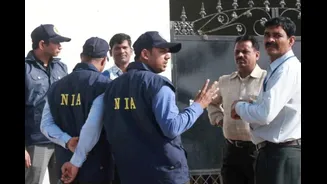
The ground preparations ahead of tomorrow's polling have been nothing short of extraordinary. On Monday night alone, more than 800 people were arrested in poll-bound districts. By the time that figure was announced, the total number of pre-poll arrests ahead of the second phase had already crossed 2,300.
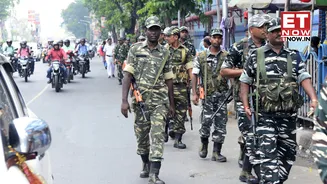
Police have been operating on the Election Commission's directive to identify and neutralise potential troublemakers before they can disrupt tomorrow's voting process. Central forces have simultaneously stepped up route marches, checkpoint inspections, and patrols across sensitive districts — a visible, deliberate show of strength designed as much to reassure genuine voters as to deter those who might seek to intimidate them.
Ahead of the first phase on April 23, a district-wise list of approximately 1,100 identified troublemakers had been circulated among CAPF personnel, with instructions for detentions and warnings. The list, which reportedly comprised largely of individuals associated with the Trinamool Congress including sitting legislators, was subsequently stayed by the Calcutta High Court — generating its own political storm before the first ballot of phase one had even been cast.
Operation All Out, Night Dominance, Kavach, Trust
The Central Armed Police Forces have given their security operations for this election a set of names that capture the dual intent of the entire exercise — All Out, Night Dominance, Kavach, and Trust. Overwhelming presence on one hand, confidence-building on the other.
When asked about the reasoning behind these names, a CAPF official was straightforward. "All of us are out in the field to ensure that the elections are held in a free and fair manner — that is why the name All Out. Night Dominance means that security forces are present in huge numbers and there is no need to be intimidated."
Then came the detail that puts everything else in perspective. "There have been several instances when people have come to us and conveyed that they were able to vote after 20 to 30 years."
That single line — voters telling security personnel they are casting a free ballot for the first time in two decades — explains more about why Bengal requires this scale of deployment than any political analysis can.
The CRPF's West Bengal Sector has been posting regular updates confirming that day-and-night patrolling and checkpoint operations are continuing across sensitive areas, with extensive flag marches and area domination exercises running simultaneously through the districts that will vote tomorrow.
An Unprecedented Scale of Deployment
More than 2.4 lakh Central Armed Police Force personnel are in position across West Bengal for tomorrow's polling. To appreciate what that number represents, consider that the 2021 assembly election — conducted over eight phases and itself considered a high-security exercise — saw around 700 companies of central forces deployed across the entire state. This time, the same state is being covered in just two phases, and the deployment is of a scale that dwarfs anything that came before.
More than 100 armoured and anti-riot vehicles have been positioned across sensitive areas. Round-the-clock area domination exercises, night patrols, and high-visibility force movement have formed the backbone of the ground-level security architecture leading into tomorrow.
The Election Commission is also deploying complete webcasting of all polling stations across the state — giving officials the ability to monitor the voting process in real time from central locations, adding a digital transparency layer that did not exist in previous Bengal election cycles.
Where the Troops Are Coming From
Assembling 2.4 lakh personnel for a single state election requires drawing resources from across the country — and the logistics reveal just how seriously the central government and the Election Commission are treating tomorrow's polling.
At least 85 companies of CAPFs, approximately 8,500 personnel, were withdrawn from Manipur — a state still gripped by ethnic conflict between the Kuki-Zo and Meitei communities that has kept around 36,000 Army and CAPF personnel engaged since May 2023. Additional troops have been drawn from Jammu and Kashmir and from Left-wing Extremism-affected areas across central India.
A CRPF official was candid about the operational strain. "The force does not have personnel in reserve," he said, acknowledging that fulfilling Bengal's election security requirement meant drawing down from active conflict and security zones elsewhere in the country. That is a significant cost — and a measure of how seriously the challenge of free and fair polling in Bengal is being treated at the highest levels.
The Historic Meeting That Set the Stage
On April 18, something occurred in Kolkata that had no precedent in any poll-bound state in India. The Directors General of all five Central Armed Police Forces — the CRPF, BSF, CISF, SSB, and ITBP — convened together in the city to finalise what officials described as a robust, technology-driven security architecture for the election.
The meeting reviewed quick response team deployments, anti-sabotage checks, and the construction of an integrated security grid designed to coordinate central and state law enforcement ahead of both phases. The fact that this gathering of top paramilitary leadership was considered necessary for a state assembly election is itself a commentary on the unique and persistent nature of Bengal's election security challenge.
The 'Singham' Controversy
Amid the massive deployment, one particular appointment generated its own political heat. The Election Commission posted Ajay Pal Sharma — a 2011-batch IPS officer from Uttar Pradesh nicknamed Singham for his reputation as an encounter specialist — as observer in the sensitive South 24 Parganas district.
A video went viral showing Sharma warning supporters of TMC candidate Jehangir Khan for allegedly intimidating voters, triggering sharp exchanges between the Trinamool Congress and the BJP and drawing considerable public attention to both the officer and his methods. The episode illustrated a truth that runs through every Bengal election — even the security apparatus itself becomes a contested political space.
Why Bengal Has Always Needed This
West Bengal's history of election-related violence stretches across decades and across political regimes. Under Left Front rule, allegations of booth capturing and voter intimidation were a regular feature of every election cycle. When Trinamool swept to power in 2011, the pattern shifted but did not disappear. The 2021 election saw significant post-poll violence that drew national attention, Supreme Court intervention, and widespread demands for accountability.
The 2026 deployment is not a response to a hypothetical threat. It is a response to documented, repeated, historically established patterns of electoral violence in one of India's most politically intense states. The Election Commission is not predicting what might happen tomorrow. It is acting on the basis of what has happened before.
May 4 Will Tell the Story
Tomorrow's voting will complete Bengal's 2026 electoral picture. The first phase on April 23 produced high turnout that both the BJP and Trinamool immediately claimed as evidence of their own momentum — with Mamata pointing to it as confirmation of a landslide and Modi framing it as the electorate demanding change. Neither reading can be verified until May 4.
What can be said with confidence is that if tomorrow's polling passes off peacefully — if voters across Bengal's districts walk to their booths without fear, cast their ballots without interference, and return home without incident — it will represent something genuinely significant in the state's democratic history.
The security forces are in position. The booths are ready. Bengal votes tomorrow.