





What is the story about?

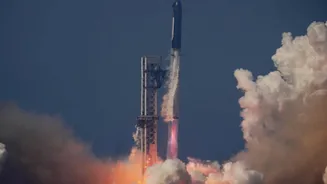
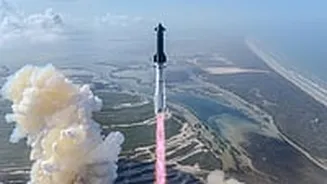
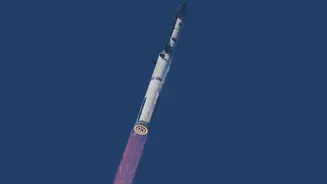
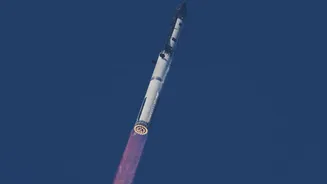
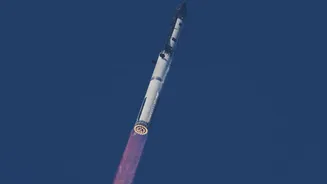
SpaceX launched its largest and most powerful Starship on a test flight on Friday, an upgraded model that NASA relies on to land astronauts on the moon.
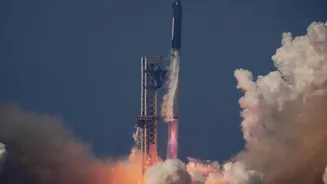
This redesigned mega rocket made its debut two days after SpaceX CEO Elon Musk announced plans for the company to go public, taking off from the southern tip of Texas with 20 mock Starlink satellites on board, intended for deployment halfway around the world.
This marks the 12th test flight of the rocket that Musk envisions will eventually transport humans to Mars. However, the immediate focus is on the moon as part of NASA's Artemis program.The last of the previous generation of Starships launched in October, while SpaceX's third-generation Starship, referred to as V3, lifted off from a newly constructed launch pad at Starbase, situated near the Mexican border. A launch attempt on Thursday was thwarted by last-minute pad issues.
SpaceX aimed to avoid the midair explosions that plagued last year's back-to-back launches, which resulted in wreckage falling into the Atlantic. Earlier flights also ended in fiery destruction.
At 407 feet (124 meters), the latest model surpasses earlier Starship versions by several feet and features increased engine thrust.
The new booster design incorporates fewer but larger and stronger grid fins to facilitate its return to Earth after liftoff, along with a more robust fuel transfer line capable of feeding the 33 main engines. This fuel line matches the size of SpaceX's Falcon 9 first-stage booster. The stainless steel spacecraft boasts enhanced capabilities, including additional cameras, navigation, and computer power, as well as docking cones for future missions to the moon.
Starship is intended to be fully reusable, equipped with mechanical arms at launch pads to catch returning rocket stages. However, during this test flight, recovery was not planned. The Gulf of Mexico marked the endpoint for the newly designed first-stage booster, while the Indian Ocean served as the destination for the spacecraft and its satellite demonstrations.
NASA is investing billions of dollars in SpaceX and Jeff Bezos’ Blue Origin to develop the lunar landers for the Artemis program, which aims to land astronauts on the moon.
Both companies are competing to be the first to achieve this milestone.
While Starship has reached the fringes of space during several flights, each lasting no more than an hour, Blue Origin's lunar lander, Blue Moon, has yet to launch, although a prototype is being prepared for a moonshot later this year.
NASA plans to follow April’s successful lunar flyby with a docking trial run in orbit around Earth scheduled for next year. This Artemis III mission will involve astronauts practicing docking their Orion capsule with either Starship, Blue Moon, or both.
A moon landing with two astronauts, designated Artemis IV, could occur as early as 2028, depending on which lander is deemed safer and ready first. This will mark NASA's first crewed lunar landing since the Apollo 17 mission in 1972. The current objective is to establish a moon base near the lunar south pole, staffed by both astronauts and robots.
SpaceX has begun taking reservations for private flights to the moon and Mars aboard Starship.
The first space tourist, California businessman Dennis Tito, and his wife reserved a flight around the moon three and a half years ago, though the timing remains uncertain.
This week, another affluent space tourist, Chinese-born bitcoin investor Chun Wang, announced plans to fly to Mars on Starship's inaugural interplanetary mission. Wang previously chartered a SpaceX polar flight in a Dragon capsule last year, becoming the first to orbit over both the North and South Poles with his chosen crew.
No pricing details or date for his Mars journey have been disclosed.
The Associated Press Health and Science Department receives support from the Howard Hughes Medical Institute’s Department of Science Education and the Robert Wood Johnson Foundation. The AP is solely responsible for all content.