






What is the story about?

DUBAI, United Arab Emirates (AP) — The Trump administration has proposed a 15-point ceasefire plan to Iran, as confirmed by a source familiar with the
proposal late Tuesday. This development comes as the U.S. military prepares to deploy at least 1,000 additional troops to the Middle East, supplementing the existing 50,000 troops in the region. The ceasefire plan was communicated to Iran through intermediaries from Pakistan, who have also offered to facilitate renewed negotiations between Washington and Tehran. The source requested anonymity due to the sensitive nature of the discussions.
The New York Times first reported that the ceasefire proposal had been delivered to Iranian officials. Concurrently, the Pentagon is moving to deploy two Marine units, which will add approximately 5,000 Marines and several thousand sailors to the area. This military buildup is perceived as a strategy by Trump to maintain 'maximum flexibility' regarding future actions, according to the source.Israeli officials, who have been urging President Trump to maintain military pressure on Iran, expressed surprise at the proposal of a ceasefire. The White House has not commented on the matter.
Earlier, President Trump indicated that the U.S. was engaged in discussions with Iran to resolve the ongoing conflict, as diplomatic efforts intensified, coinciding with renewed Iranian defiance. Meanwhile, airstrikes continued against Iranian targets while Iranian missiles and drones targeted Israel and other regional sites.
Iran has denied any ongoing negotiations, and Trump has postponed his self-imposed deadline for Iran to reopen the Strait of Hormuz, a crucial waterway that has disrupted international shipping and escalated fuel prices, posing risks to the global economy.
Any potential talks between the U.S. and Iran are expected to encounter significant obstacles. Washington's fluctuating objectives, particularly concerning Iran's ballistic missile and nuclear ambitions, complicate the negotiation landscape.
It remains uncertain who within the Iranian government possesses the authority to negotiate or would be willing to engage, especially given Israel's commitment to continue targeting Iranian leadership.
Iran's mistrust of the U.S. is profound, stemming from previous attacks during high-level diplomatic engagements, including strikes that initiated the current conflict.
Reports indicate that at least 1,000 troops from the 82nd Airborne Division will be deployed to the Middle East in the coming days, as confirmed by three individuals with knowledge of the plans. The 82nd Airborne is designated as the Army's rapid response unit and can typically be mobilized quickly. This marks the latest troop increase following U.S. officials' announcements regarding the deployment of thousands of Marines aboard Navy ships headed to the region.
While the Marine units are trained for various missions, including embassy support and civilian evacuations, the 82nd Airborne specializes in securing key territories and airfields in hostile environments.
The deployment of Marines has led to speculation that the U.S. may attempt to seize Kharg Island, essential to Iran's oil infrastructure. The U.S. previously targeted the island's defenses, claiming to have spared its oil facilities.
Iran has threatened to mine the Gulf if U.S. forces appear poised to land troops. Trump has indicated he would refrain from attacking Iran’s power stations while negotiations are ongoing, a strategy possibly intended to allow time for the Marines' arrival, according to an analysis by the New York-based Soufan Center.
Prime Minister Shehbaz Sharif of Pakistan announced on social media that Pakistan is prepared to host meaningful talks aimed at concluding the Iran conflict. The U.S. has reportedly agreed in principle to participate in discussions in Pakistan, as confirmed by three Pakistani officials and one Egyptian official, while mediators continue efforts to persuade Iran.
One regional diplomat mentioned that talks could commence as early as next week, with U.S. special envoy Steve Witkoff and Jared Kushner, Trump’s son-in-law, expected to represent the U.S. These officials spoke on the condition of anonymity due to the sensitive nature of the discussions.
During a press briefing, Trump stated that the U.S. is currently in negotiations, involving key figures such as Witkoff, Kushner, Secretary of State Marco Rubio, and Vice President JD Vance. He remarked, 'We have a number of people doing it. And the other side, I can tell you, they’d like to make a deal.'
However, Iranian Foreign Minister Abbas Araghchi has been in discussions with several counterparts regarding the conflict, while Iranian parliamentary speaker Mohammad Bagher Qalibaf refuted Trump’s claims of direct talks, asserting that hostilities would persist.
Maj. Gen. Ali Abdollahi Aliabadi stated, as reported by Iranian state television, 'Iran’s powerful armed forces are proud, victorious, and steadfast in defending Iran’s integrity, and this path will continue until complete victory.'
Efforts are currently focused on building trust between the U.S. and Iran, with the objective of achieving a pause in fighting. Israel is not involved in these negotiations. The priority remains to safeguard regional energy infrastructure while working on a mechanism for Iran to reopen the Strait of Hormuz.
Speculation regarding negotiations briefly led to a decline in oil prices and an increase in stock values. However, this respite was short-lived, with Brent crude prices surpassing $100 a barrel, marking a nearly 40% increase since the onset of the conflict.
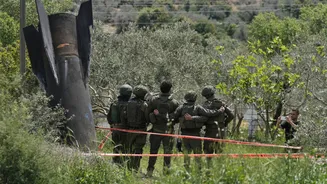
In related developments, Israel conducted a series of airstrikes targeting Iranian production sites, although no further details were provided. Reports from Tehran indicated explosions in northern neighborhoods and the city center.
Iran launched multiple missile strikes against Israel, resulting in injuries to civilians in southern Israel and Tel Aviv. Additionally, an Iranian attack in Bahrain resulted in the death of a Moroccan contractor working with the United Arab Emirates' armed forces.
In Kuwait, air defense debris caused partial power outages, while Saudi Arabia reported the interception of Iranian drones aimed at its oil-rich Eastern Province. Israel targeted infrastructure in Beirut associated with the Iran-aligned Hezbollah group, leading to civilian casualties, including a child.
In northern Israel, a woman was killed by shrapnel from an attack originating in Lebanon. Meanwhile, Lebanon declared Iran's ambassador persona non grata, demanding his departure by Sunday.
Iranian flights have been barred from landing in Lebanon to prevent the transport of weapons or funding to Hezbollah, with some Lebanese officials accusing Iran of instigating further conflict with Israel.
___
Madhani reported from Washington. Rising reported from Bangkok, and Magdy reported from Cairo. Associated Press writers contributed to this report.