






What is the story about?

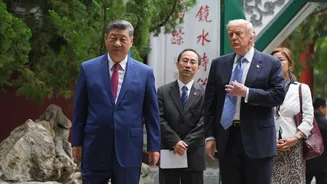
U.S. President Donald Trump departed Beijing on Friday following a final meeting with Chinese President Xi Jinping. The leaders said they made progress
in stabilizing U.S.-China relations, but deep differences remained after two days of meetings and meals. On Friday, they walked the grounds of Zhongnanhai, Xi's official residence, and had a working tea and lunch. During a series of meetings and events Thursday, the two discussed divisive issues such as the Iran war, trade, technology, and Taiwan.
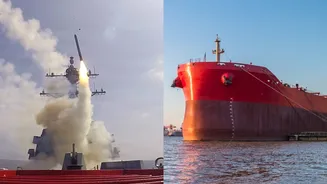
China has shown little public interest in getting more involved in solving the war in Iran. Xi also suggested that differences over Taiwan could put his country and the U.S. on the path toward conflict. Threats of each side imposing steep tariffs also still loom.Trump stated that Xi told him China wants to help negotiate an end to the war and a reopening of the Strait of Hormuz. As the largest buyer of Iranian oil, China has the leverage to influence Iran toward a deal favorable to the U.S. Trump also mentioned that Xi assured him that China would not provide military equipment to Iran.
President Trump extended a September 24 invitation to Xi and his wife during his reciprocal toast at a banquet Thursday. According to a readout from the Chinese foreign minister, Wang Yi, Trump and Xi agreed to maintain close contact through meetings, phone calls, and letters, as reported by the Chinese official news agency Xinhua.
Wang indicated that both sides should work together to prepare thoroughly for the leaders’ interactions and create a conducive atmosphere for achieving more results. Meanwhile, German Chancellor Friedrich Merz expressed that he and Trump agree that Iran must open the Strait of Hormuz, stating, 'We agree: Iran must come to the negotiating table now. It must open the Strait of Hormuz. Tehran must not be allowed to have nuclear weapons.'
Trump informed reporters on Air Force One that China would purchase 200 planes from Boeing, with a potential expansion to 750 depending on the performance of the initial order. This would represent Boeing's first significant sale to China in nearly a decade and a crucial win for Trump’s trade agenda.
Additionally, Trump noted that China would buy 400 to 450 engines from General Electric, although he did not specify an exact number. Trump also discussed the case of Ezra Jin Mingri, a pastor detained in China, indicating that Xi would consider the matter. Grace Jin Drexel, the pastor’s daughter, urged Trump to advocate for her father’s release.
In another development, the Kremlin announced that President Vladimir Putin is set to visit China shortly, with expectations for Moscow to gain insights from China regarding its discussions with the U.S. Trump has yet to decide on a major U.S. arms sale to Taiwan, which remains a contentious issue in U.S.-China relations.
Trump also mentioned that he raised the case of activist Jimmy Lai with Xi, who was sentenced to 20 years in prison under a national security law in Hong Kong. Trump described Xi’s response as acknowledging the complexity of the situation.
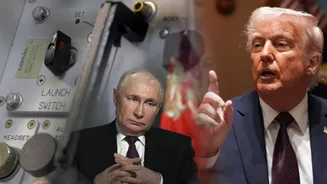
During the summit, Trump expressed a desire for a nuclear arms agreement involving the U.S., Russia, and China, proposing a pact to limit the number of nuclear warheads. Although China has been hesitant to enter such agreements, Trump indicated that Xi appeared receptive to the idea during their discussions.
Analysts noted that the summit unfolded with a sense of scripted precision, providing clarity and a roadmap for future interactions. George Chen from The Asia Group consultancy remarked that while concrete outcomes were limited, the extended time spent together could foster a more favorable bilateral relationship.
As the summit concluded, Xi emphasized the importance of a 'constructive China-U.S. relationship of strategic stability,' aiming to keep the relationship balanced and focused on cooperation while managing differences. Trump received an exuberant farewell at the airport, where schoolchildren waved flags as he boarded Air Force One, signaling a moment of mutual respect despite ongoing challenges.
In summary, both leaders expressed optimism about their discussions, highlighting the need for continued dialogue and cooperation, even as significant issues remain unresolved. The visit is expected to shape the U.S.-China relationship in the coming years.