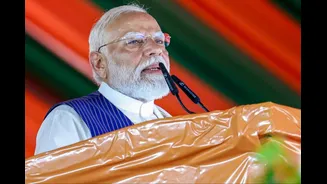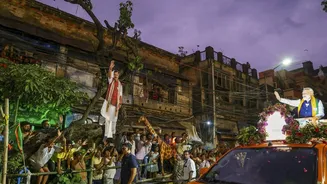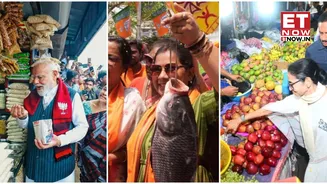









It lasted barely a few minutes. Prime Minister Narendra Modi, on a visit to Jhargram, stepped off his scheduled itinerary and walked up to a small roadside
stall. He handed over a Rs 10 note, picked up a paper cone of jhalmuri, and ate it on the spot. No fork, no table, no protocol. The cameras caught it. The internet ran with it. And within hours, what appeared to be a casual, spontaneous moment had detonated across West Bengal's political landscape like a well-aimed firecracker. For anyone who has watched Indian politics long enough, nothing about that scene was accidental. A Prime Minister known for his carefully managed public image, stepping away from his hygiene-conscious persona to eat the cheapest, most democratic street snack Bengal has to offer — this was not impulse. This was intent. And intent, in an election where cultural identity is being fought over more fiercely than policy positions, carries enormous weight.
Mamata Fires Back — With a Shopping Basket
The Chief Minister of West Bengal does not let a political move go unanswered. Within days of Modi's jhalmuri moment making headlines, Mamata Banerjee was photographed doing her own version of cultural outreach — stopping at a vegetable market in Bhabanipur on her way back from a rally, inspecting vegetables, chatting with vendors, and even tossing fruits into her shopping basket.
For those tracking the BJP-TMC war of symbolism, the timing required no explanation. The Chief Minister is known to visit the vegetable market of her constituency occasionally, but this particular trip — days after Modi made headlines with his jhalmuri break — was not lost on anyone.
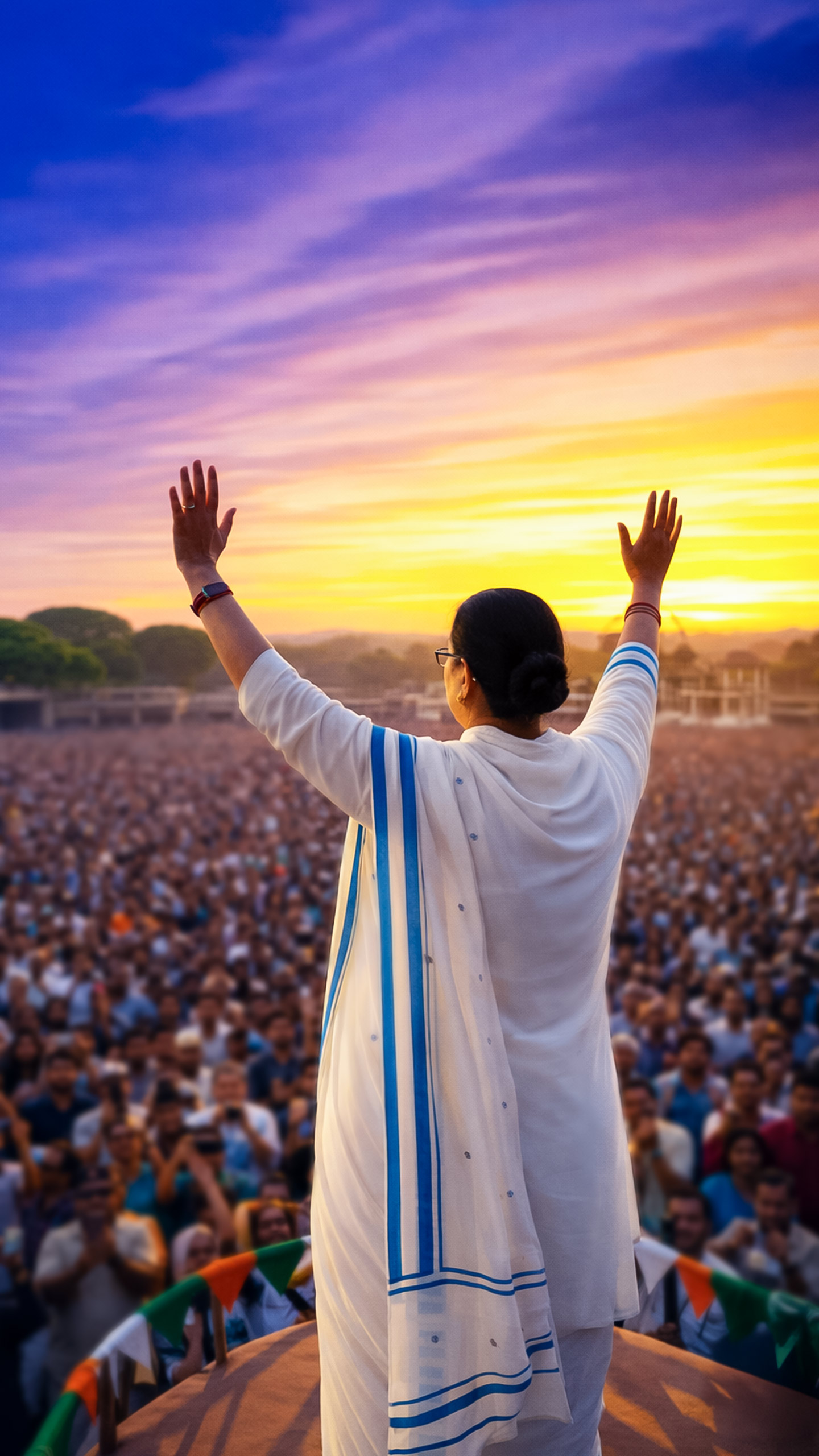
Dressed in her trademark white saree, she moved through the market the way she always does in public — accessible, unhurried, stopping to speak with shoppers and vendors about prices of potatoes, onions, and seasonal produce. The message embedded in those images was aimed squarely at the same audience Modi had been reaching for in Jhargram: the ordinary Bengali household managing its daily budget and its daily meals.
Two leaders. Two markets. One election.
The Fish Enters the Frame
If jhalmuri opened this particular chapter of Bengal's food politics, it was fish that turned it into a full-scale war of narratives.
The ruling Trinamool Congress has repeatedly warned voters that their food habits — especially fish and meat consumption — could come under threat if the BJP comes to power. Mamata has been unambiguous about this at her rallies, telling crowds that fish is not eaten in BJP-ruled states and warning that a change in government could mean restrictions on what Bengalis put on their plates.
It is a potent line of attack in a state where, according to a 2024 joint study by ICAR and WorldFish, about 65.7% of people eat fish at least once a week. Fish in Bengal is not merely food. It is ritual, identity, and pride compressed into a single item on the daily menu. To suggest that a political party might take that away is to suggest something far more threatening than a dietary inconvenience.
The BJP, recognising the danger of this narrative, has responded with its own performances at the table. Union Minister Anurag Thakur was seen publicly eating fish with party workers — a symbolic gesture aimed at softening the party's image. In a viral video, Thakur and other BJP leaders were shown relishing shorshe maach bhaat — fish cooked in mustard gravy with rice — on the last day of campaigning before the first phase of polling. State leaders including Suvendu Adhikari and Sukanta Majumder joined the same visual chorus, each photograph a deliberate counter to the TMC's claim of BJP being anti-Bengali in its eating habits.
The Catla Fish and the Door-to-Door Campaign
The fish symbolism did not stay confined to restaurants or staged meals. In the streets of Kolkata's Salt Lake, BJP candidate Sharadwat Mukherjee from Bidhanagar went door to door canvassing while waving a large Catla fish — a campaign image that neatly captured how culture and politics remain deeply intertwined in the state.
It was absurd, in the best possible way. It was also completely logical within the grammar of Bengali political communication. In a constituency where identity politics runs deep, carrying a Catla fish was a more direct statement of cultural allegiance than any manifesto point could be. It said: I am not afraid of your fish. I eat your fish. I am of this place.
Bahiragoto Versus Bhumi-Putra — The Outsider Question Returns
The food battles of 2026 cannot be fully understood without placing them within Bengal's long-running debate about who truly belongs here. The "Bahiragoto" versus "Bhumi-putra" tension — outsider against son of the soil — was a defining factor in 2021, when Mamata successfully ran on the platform of being "Banglar Nijer Meye," Bengal's own daughter, against what TMC framed as an invasion of outside political forces.
In 2026, the terrain has shifted somewhat. The BJP now has an abundance of Bengali faces in the state, and the phrase has comparatively died down compared to 2021. The party's calculation is clear — if you can neutralise the outsider charge by fielding enough local faces, you remove one of TMC's most reliable emotional weapons.
But the food politics is, in many ways, an extension of that same insider-outsider argument. When Mamata warns that BJP rule means restrictions on fish and meat, she is essentially restating the Bhumi-putra argument in culinary terms: these people do not understand Bengal, do not share Bengal's traditions, and will impose alien values on Bengali life. Every jhalmuri photograph, every public fish meal, every vegetable market visit from either side is a response to that underlying question of authenticity.
The Durga Puja Dimension
Food does not exist in isolation in Bengal's cultural politics. It sits within a much larger ecosystem of community identity — and nothing captures that ecosystem more completely than Durga Puja.
Mamata Banerjee provides substantial funding to clubs for the organisation of Durga Pujas and presides over the Durga visarjan procession on Red Road. Several of her top confidants run major Pujas across the city — the Suruchi Sangha Puja, the Ram Mohan Mission Puja, each of them a gathering point for thousands of Bengali families who associate the festival's grandeur with TMC's stewardship of the city's cultural life.
The BJP has attempted to enter this space as well. Sajal Ghosh, a BJP candidate from Baranagar, organises the Santosh Mitra Square Durga Puja committee — one of the BJP's deliberate moves to build community connect in Kolkata.
The bhog — the community meal served at Durga Puja pandals, typically khichuri, labra, and chutney — is itself a form of food politics. Whoever feeds the neighbourhood during Puja owns a piece of its affection. Both parties understand this completely.
The Missteps That Cut Deep
Cultural fluency in Bengal is not just about what you eat. It is also about what you know, how you speak, and whether you show genuine familiarity with the state's history and its icons.
PM Modi's reference to Bankim Chandra Chattopadhyay as "Bankim da" drew a sharp correction from TMC MP Sougata Ghosh, and the incident received significant public attention. Similarly, Sports Minister Mansukh Mandaviya's mispronunciation of Mohun Bagan and East Bengal — two of Bengal's most iconic football clubs — drew substantial criticism.
These are not trivial errors in a state where identity runs this deep. To mispronounce the name of a football club that Bengalis have supported for over a century is to reveal, in an unguarded moment, the distance between a leader and the culture they are seeking to inhabit. The TMC has been quick to use each such moment as evidence of the BJP's fundamental unfamiliarity with Bengal.
Beyond the Bengali Plate — A More Complex Electorate
One of the complications that food politics tends to obscure is how layered West Bengal's electorate actually is. Large populations of Marwari, Gujarati, and Punjabi communities have long been embedded in the state's economic and social fabric. These communities vote, they have economic influence, and their loyalties do not map neatly onto the Bengali identity narrative that dominates the campaign's most visible moments.
Neighbourhoods like Bhabanipur — Mamata's political stronghold — have a sizeable share of non-Bengali voters, yet local culture remains deeply syncretic. A famous dhaba on Harish Mukherjee Road, run by non-Bengalis but beloved by locals, has even become a minor cultural landmark in its own right.
Maharashtra Chief Minister Devendra Fadnavis, during an April 2026 visit to Kolkata, spoke of taking Bengali cuisine global — promising that a BJP government would promote local specialities, including sweets, as international food. It was a conscious attempt to reframe the BJP's relationship with Bengali food culture: not as a threat to be neutralised but as a tradition to be celebrated and elevated.
Whether that reframing has reached ground level, in the villages of Birbhum or the small towns of Nadia, is another question entirely.
What the Turnout Has Already Told Us
The first phase of polling in West Bengal produced high turnout numbers that both parties immediately claimed as evidence of their own momentum. The interpretations could not have been more different.
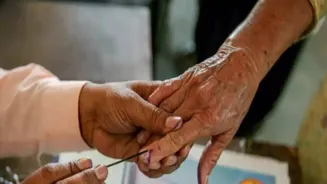
Mamata pointed to high turnout in districts like Alipurduar, Coochbehar, Uttar Dinajpur, Malda, and Murshidabad as confirmation of a TMC landslide in the making, framing voter participation as a direct rejection of the BJP's electoral roll revision exercise.
Modi, speaking in Panihati, offered a completely different reading — that the same turnout figures reflected a population that came out to demand change after years of TMC rule.
Political analysts, more cautiously, note that turnout numbers alone reveal very little. What matters is the regional texture beneath them — which constituencies moved, which communities came out in higher numbers than before, and whether the food and identity battles of the campaign translated into actual ballot behaviour.
The Honest Reckoning
Strip away the jhalmuri photographs, the fish meals, the vegetable basket, and the Catla fish held aloft on a Bidhanagar street, and you are left with a fundamental question that no amount of cultural performance can answer on its own: have the daily lives of ordinary Bengali households improved enough over fifteen years of Trinamool rule to justify continued trust?
The food politics works when it reinforces what voters already feel. It struggles when it runs against the grain of lived experience. A family worried about the rising price of mustard oil is not necessarily reassured by a photograph of the Chief Minister at a vegetable market. A farmer who has not received a fair price for his paddy is not automatically moved by a Union Minister eating shorshe maach.
The brilliance of food as political symbolism is that it communicates belonging, familiarity, and shared identity without making specific promises that can be held against a candidate. Its limitation is that it cannot substitute for governance when governance is what voters are weighing most heavily.
Bengal's Verdict Is Still Being Cooked
What the 2026 West Bengal assembly election has demonstrated, even before its results are declared, is that the battle for this state is fought on terrain that is distinctly its own. The language of fish and jhalmuri, of Durga Puja bhog and neighbourhood vegetable markets, is a language that belongs specifically here — one that outsiders can learn phrases of but rarely speak fluently.
Mamata Banerjee has spoken it for decades. The BJP is working hard to learn it. And Bengal's voters, sharp and politically seasoned as any electorate in the country, are listening carefully — to the words, yes, but also to the accent.
The results on May 4 will tell us whose Bengali passed the test.