







What is the story about?

SEOUL, South Korea (AP) — Chinese President Xi Jinping and North Korean leader Kim Jong Un underscored their commitment to deepen cooperation in a closely
watched summit on Monday, as Xi made a rare visit to Pyongyang in a likely attempt to reassert Beijing’s unique influence over its socialist neighbor. It's Xi's first visit to North Korea in seven years. Earlier Monday, he was given a lavish welcome upon arrival at Pyongyang's international airport. He and his wife, Peng Liyuan, were greeted by Kim and his wife, Ri Sol Ju, who broadly smiled and clapped.
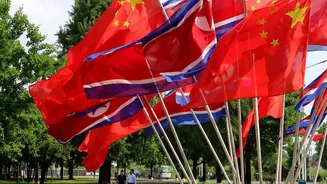
Xi later arrived at Pyongyang’s main square, where a military honor guard and thousands of people, including children carrying balloons and hopping, staged a welcoming ceremony. Buildings surrounding the plaza were draped in the two countries’ flags, giant portraits of Kim and Xi, and red-and-yellow banners welcoming the Chinese leader and celebrating the nations’ 'friendship and unity.'In a summit later Monday, Xi expressed China’s willingness to expand cooperation in a wide range of areas including trade, agriculture, construction, and technology, China's state broadcaster CCTV reported. Xi stated that the two countries should strengthen strategic cooperation and firmly safeguard their respective sovereignty and security interests, according to the report.
Kim remarked that Xi's visit 'clearly demonstrates how unbreakable' the North Korean-China relationship is, with CCTV citing him as saying that consolidating a new era of friendship between the two countries is the 'unchanging strategic choice' of North Korea.
Full details of the meeting weren't available. However, foreign experts earlier predicted that the meeting would have significant ramifications on bilateral ties and beyond, as both leaders seek to fully restore their traditional alliance in the face of separate confrontations with the U.S.
Xi and Kim last met in Beijing in September after viewing a military parade alongside Russian President Vladimir Putin and other foreign leaders. Xi’s trip comes after his back-to-back summits with U.S. President Donald Trump and Putin in Beijing last month, and he is expected to meet Trump again during a planned U.S. visit in September.
Analysts suggest that Xi will try to demonstrate China’s 'sway over the Korean Peninsula' and 'a leadership role in entire Northeast Asia in the age of strategic competition with the U.S.,' as noted by Kwak Gil Sup, the head of One Korea Center, a website specializing in North Korea affairs.
China has long been North Korea's economic lifeline and main diplomatic backer. Experts assert that China has avoided fully enforcing U.N. sanctions on North Korea and has sent clandestine aid to help its impoverished neighbor remain afloat. This year marks 65 years since the two countries signed a mutual defense treaty.
Nonetheless, there have been questions regarding their ties in recent years, with North Korea prioritizing cooperation with Russia by supplying troops and weapons to support its war against Ukraine. In return, North Korea has received economic and military assistance from Russia.
Restoring exclusive influence over North Korea would provide Xi with leverage in dealings with Trump, who has repeatedly expressed a desire to restart diplomacy with Kim, experts suggest. 'Implementing U.N. Security Council resolutions and enforcing sanctions do not appear to be priorities for China,' stated Leif-Eric Easley, a professor at Ewha Womans University in Seoul.
Last year, two-way trade volume between China and North Korea recovered to pre-pandemic levels. Earlier this year, the countries also resumed direct flights and passenger trains, which had been stalled since the pandemic. Xi indicated on Monday that both nations should utilize the reopening of flight and train services as an opportunity to enhance people-to-people exchanges.
Xi is likely to offer Kim economic aid packages, including shipments of rice and fertilizers, a resumption of Chinese group tourism to North Korea, and joint economic projects, analysts predict. 'North Korea can’t solely rely on Russia. It needs to align with China,' Kwak said.
Moreover, Xi could refrain from pressing Kim on the issue of denuclearization of North Korea, instead vaguely discussing peace and stability on the Korean Peninsula. This approach would be essential for Kim, who is eager to gain international recognition as a nuclear weapons state as a means to call for the lifting of U.N. sanctions on North Korea.
'Chinese officials have taken the position of not speaking publicly about denuclearization on the Korean Peninsula while still maintaining it as a long-term goal. Kim appears to want Xi to accept North Korea as a nuclear neighbor,' Easley noted.
Following last month’s summit between Trump and Xi, the White House stated that the two leaders confirmed their shared goal to denuclearize North Korea. However, China only mentioned that the leaders discussed the nuclear issue on the Korean Peninsula. On Sunday, Kim’s sister and senior official, Kim Yo Jong, echoed her brother, dismissing as an 'anachronistic dream' a U.S. push for the denuclearization of North Korea.
Last week, Kim unveiled a new plant to produce nuclear ingredients and vowed to bolster the country’s nuclear forces 'at an exponential rate.' He also observed sea trials of a new naval destroyer and called for expediting efforts to build a nuclear-armed navy.
South Korean President Lee Jae Myung informed reporters on Monday that North Korea is producing enough nuclear ingredients annually for approximately 10 to 20 bombs and is close to perfecting intercontinental ballistic missile technology. Lee emphasized that the world must first focus on persuading North Korea to freeze its nuclear materials production and ICBM program as a short-term goal.
Kim Jong Un has concentrated on enlarging and modernizing his nuclear arsenal since his high-stakes diplomacy with Trump collapsed in 2019. The North Korean leader stated in September that he still had 'good personal memories' of Trump but urged the U.S. to withdraw its demand for North Korea to denuclearize as a precondition for resuming diplomacy.