








What is the story about?

NEW YORK (AP) — Oil prices rose Monday following the latest fighting that threatens the U.S.-Iran ceasefire, but Wall Street remains unfazed, with U.S. stocks
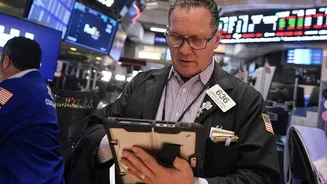
reaching new records. The S&P 500 increased by 0.3% from its previous all-time high set on Friday. The Dow Jones Industrial Average added 46 points, or 0.1%, while the Nasdaq composite rose by 0.4%, also achieving record highs.
A slight majority of U.S. stocks declined, including companies burdened by rising fuel costs. United Airlines dropped 2.6%, and Alaska Air Group fell 3.3% as the price for a barrel of Brent crude oil climbed 4.2% to settle at $94.98, recovering some of last week's losses and remaining significantly above its price of approximately $70 prior to the conflict.Rising oil prices have already contributed to increased inflation, impacting household expenses and yields in the bond market. Recently, high global yields have posed a risk of slowing economies and suppressing stock prices and other investments.
However, yields eased during the day after oil prices retreated from their peaks, alleviating some pressure on Wall Street. The Russell 2000 index, which tracks smaller U.S. companies, recovered from a 1.3% loss to finish down 0.5%. Smaller firms are particularly sensitive to increased borrowing costs, which many require to facilitate growth.
Despite these challenges, optimism persists on Wall Street regarding a potential agreement between the United States and Iran that could reopen the Strait of Hormuz, allowing oil deliveries to resume from the Persian Gulf and easing inflationary pressures.
Support from several key market players also contributed to Wall Street's gains. Nvidia emerged as a significant force, rising 6.2% after CEO Jensen Huang unveiled several product updates at a conference. Nvidia's performance holds considerable weight on the U.S. stock market due to its substantial market value, affecting the S&P 500 more than any other stock.
The dominance of major corporations has been notable, with the top 10 stocks commanding nearly half of the S&P 500's total market value, the highest proportion in 40 years, as noted by Thomas Carroll, equity market strategist at Stifel.
This trend has favored Big Tech stocks, which surged amid enthusiasm surrounding artificial intelligence. However, Carroll cautions that such concentration could negatively impact the index if the market's leadership diversifies, as stagnation or declines in Big Tech could hinder S&P 500 index funds.
Carroll indicated in a report that a critical market breadth indicator suggests a rotation may be imminent.
In other market developments, Science Applications International Corp. experienced a 10.4% increase after reporting better-than-expected profits for the latest quarter and raising its forecasts for future financial results.
A surge of positive earnings reports has propelled the U.S. stock market to new heights despite the uncertainties posed by the ongoing conflict in Iran.
Berkshire Hathaway saw a 0.9% decline after announcing its acquisition of homebuilder Taylor Morrison Home for $6.8 billion, marking one of the first significant deals since Greg Abel succeeded Warren Buffett as its leader. In contrast, shares of Taylor Morrison Home surged by 22.3%.
MGM Resorts International soared by 16.1% after Barry Diller's company, People Inc., proposed to buy the remaining shares of MGM it does not already own for $48.30 per share in cash.
Overall, the S&P 500 increased by 19.90 points to 7,599.96. The Dow Jones Industrial Average gained 46.42 points to reach 51,078.88, and the Nasdaq composite rose by 114.19 points to 27,086.81.
In the bond market, Treasury yields rose alongside oil prices and following a report indicating that U.S. manufacturing growth accelerated more than economists anticipated last month. The yield for the 10-year Treasury briefly approached 4.52% before falling back to 4.46%, up from 4.45% late Friday.
High yields have already driven the average long-term U.S. mortgage rate to its highest level in nine months and could limit companies' ability to borrow for constructing AI data centers that have recently bolstered U.S. economic growth.
Internationally, stock markets in Europe declined following a strong performance in Asia. Tokyo's Nikkei 225 index rose by 0.9% to an all-time high, with SoftBank Group, an investment firm focused heavily on AI, surging 21.2% to surpass Toyota as Japan's most valuable listed company.
In South Korea, the Kospi index climbed 3.7% to a record high after data revealed a 53% increase in the country's exports in May compared to the previous year, driven by global demand for semiconductors.
___
AP Business Writers Chan Ho-him and Matt Ott contributed.