





![[In pictures] Harshit Rana flaunts swanky Lamborghini ahead of T20 World Cup 2026](https://g-mob.glance-cdn.com/public/fc/image/VacJo0r3ws80.webp)
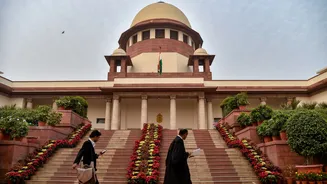
The year 2025 witnessed a series of landmark judicial interventions by the Supreme Court, high courts and the National Company Law Tribunals (NCLT). Many
cases saw dramatic reversals, intense public debate and far-reaching implications for governance, environment, economy and free speech.
From the Aravalli hills definition to regulation of digital platforms and comedians, here are the top 10 court cases of 2025 that dominated legal and public discourse:
Aravalli hills definition saga
On November 20, the Supreme Court accepted a definition of Aravalli hills and Aravalli range, ruling that only land formations rising 100 metres or more would qualify as Aravalli hills.
Environmental activists strongly criticised the judgment, arguing that the Aravalli range comprises not just hills but also ridges, slopes and shallow hillocks.
They warned that excluding lower-lying areas would make vast stretches vulnerable to mining, undermining the Aravallis’ critical role in groundwater recharge and in preventing desertification of the northern plains.
The Centre, however, assured the court that no new mining leases would be granted until a management plan for sustainable mining (MPSM) is finalised.
Later on December 29, the apex court put the new definition in abeyance, ordering a constitution of a new committee to analyse all the concerns in the matter.
ALSO READ |'Flicker of hope': What political parties said about Supreme Court's stay on Aravallis redefinition order
Vodafone Idea AGR case
In a major shift, the Supreme Court, on October 27, allowed the Department of Telecommunications to grant AGR relief to Vodafone Idea, reversing its earlier hardline stance.
The court observed that in light of peculiar facts such as the Centre's stake in the telecom company, and considering the impact on 20 crore consumers, it sees no impediment in the Centre reconsidering the issue and taking an appropriate call.
The court had upheld the AGR demand, noting that the government holds a 49% stake in the telecom operator and the issue has a substantial public interest.
JSW Steel-BPSL resolution: Rejection then approval
The insolvency saga of Bhushan Power and Steel Ltd (BPSL) took a dramatic turn. On May 2, the Supreme Court scrapped JSW Steel’s ₹19,700-crore resolution plan.
However, on September 26, the court reversed its earlier ruling, upholding the plan.
The apex court rejected a plea by the Committee of Creditors (CoC) seeking an additional ₹6,100 crore, citing BPSL’s EBITDA during the insolvency period. The court ruled that such claims have no basis under the Insolvency and Bankruptcy Code (IBC).
Presidential Reference: Timelines for Bills' assent
On April 8, a Supreme Court Bench of Justices JB Pardiwala and R Mahadevan sharply criticised states’ governors for sitting indefinitely on Bills passed by state Assemblies and prescribed a three-month deadline for the governors and the president to clear legislation.
On May 13, President Droupadi Murmu sought the court’s opinion on whether such timelines could be imposed.
On November 20, a five-judge constitution Bench, led by then CJI BR Gavai, held that no judicially enforceable timelines could be fixed for the president or governors under the Constitution. The apex court, however, ruled out the possibility of “withholding assent simpliciter,”stating that a governor cannot refuse to sign a Bill and keep it in cold storage.
The judges clarified that while the merits of a governor’s decision are not open to scrutiny, “prolonged, unexplained, and indefinite inaction” can be reviewed in court. Article 361’s personal immunity for governors does not shield the office from judicial examination of constitutional delays.
ALSO READ | SC settles law on Governor's powers: Constitution Bench answers 14 questions in Presidential Reference
Ex-post facto environmental clearance
On May 16, the Supreme Court struck down a government notification allowing retrospective environmental clearances for various environmental projects.
A Bench of Justices Abhay S Oka and Ujjal Bhuyan said it "must come down very heavily" on the Centre's attempt to do "something which is completely prohibited under the law." "The Union Government, as much as individual citizens, has a constitutional obligation to protect the environment," the Bench said.
"Cleverly, the words ex post facto have not been used, but without using those words, there is a provision to effectively grant ex post facto EC. The 2021 OM has been issued in violation of the decisions of this court…" it added, declaring the 2021 office memorandum (OM) and related circulars “arbitrary, illegal, and contrary" to the Environment (Protection) Act, 1986 and the Environmental Impact Assessment (EIA) Notification, 2006.
On November 18, the court reversed its own ruling in a 2:1 split verdict and permitted ex-post facto clearances. The apex court held that the earlier court judgment would lead to demolition of public projects worth ₹20,000 crore.
"Public projects of ₹20,000 crore will have to be demolished if the clearance is not reviewed. In my judgment, I have allowed the recall. My judgment has been criticised by my brother...Justice Bhuyan,” the then CJI Gavai had said.
Stray dogs case
The issue of stray dogs saw multiple, and at times contradictory, directions from the apex court.
On August 11, the court ordered removal of all stray dogs from Delhi streets within eight weeks. Later, in the same month, it directed authorities to round up dogs for sterilisation and release them back in the same areas. The directives were made in a suo motu case initiated on July 28 over stray dog bites leading to rabies in the national capital.
On November 7, the court directed that strays must be removed from institutional areas such as schools, railway stations and hospitals. The apex court ruled that dogs should not be released back in the same area and should be rehabilitated in designated shelters.
ALSO READ | Teachers in Delhi to be appointed nodal officers in stray dog-related matter; associations raise concerns
X Corp vs government
The Karnataka High Court on September 23 rejected X Corp’s (formerly Twitter) challenge to the government’s content takedown powers under the IT Act.
X Corp argued that “any Tom, Dick and Harry officer” could issue takedown orders.
"No social media platform can feign exemption from the law of the land. India cannot be treated as a playground in disregard of its laws," the high court ruled, adding that the X Corp complies with takedown regulations in the United Steates but resisted similar rules in India.
Sandesara brothers settlement
The Supreme Court, on November 19, said all the criminal proceedings against Nitin and Chetan Sandesara, dubbed the Sandesara brothers, be dropped if they agreed to deposit ₹5,100 crore as part of a settlement.
"If the petitioners (Sandesara brothers) are ready to deposit the amount as settled in the one-time settlement (OTS), and public money comes back to lender banks, the continuation of the criminal proceedings would not serve any useful purpose," a Bench headed by Justice JK Maheshwari said, setting December 17 as the deadline.
The court later verified that the fugitive billionaire brothers have settled the payment and closed the case.
Legal experts raised red flags, pointing out that no statutory mechanism exists for settling criminal cases in this manner, warning that the ruling could set a controversial precedent.
Vedanta demerger
The National Company Law Tribunal (NCLT), on December 16, approved Vedanta’s demerger scheme, rejecting the government’s objections related to outstanding dues and alleged disclosure violations. The ruling paved the way for one of India’s largest corporate restructurings.
The NCLT approval paved the way for Vedanta to split into five separate listed entities, including the already listed Vedanta Ltd.
Once the demerger is completed, each business will operate as an independent entity with its own leadership and capital allocation strategy.
‘India's Got Latent’ row
The India’s Got Latent case in the Supreme Court made headlines, with the Chief Justice of India pulling up comedians Samay Raina, Vipul Goyal, Sonali Thakar and Nishant Tanwar.
The court observed that influencers were “monetising free speech” and directed them to issue apologies.
It also told the Centre that a regulatory vacuum exists and called for the development of a framework to regulate social media and digital content creators.
2025: A year of reversals and reckoning
2025 stood out for the Supreme Court’s reconsideration of its own rulings, sparking debates on judicial consistency, executive accountability and the balance between development and rights.
As these judgments continue to shape policy and public life, their long-term impact will be closely watched in the years ahead.