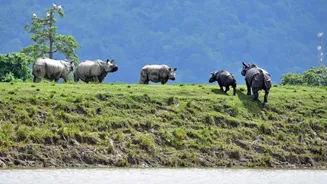

Four bone fragments, identified as belonging to anIndian rhino, were unearthed at Molapalayam, a neolithic site, according to a report in The Times of India. This proves the species once roamed as far south as Tamil Nadu, far beyond its current habitats in the swampy grasslands and riverine forests of Assam and Bengal.
According to experts, the discovery suggests a significantly different prehistoric landscape. “The animal needs grasslands and marshes. The foothills of the Western Ghats might have had grassland, as a single rhino requires many square kilometres of grassland for food,” zooarchaeologist Pramod Joglekar was quoted as saying by the English daily.
During two excavation seasons in 2021 and 2024, archaeologists recovered a huge collection of bone fragments from different species at the Molapalayam. Among these remains, four fragments were identified as two metacarpals and two carpals from the foot of an Indian one-horned rhinoceros.
“The anatomical features of the bones match the rhino bones available in the reference collection,” according to Abhayan G S, a faculty member at the Department of Archaeology, University of Kerala.
This is the third confirmed discovery of
“This is a significant find, as rhinos survived up to the middle of the second millennium BCE. According to the current zoogeography, the animal is restricted to Assam and the northeastern plains of India,” said Abhayan, who studied the samples along with research scholar Ajith M.
Similar finds have been made in Gujarat, Haryana, and Odisha, showcasing the rhino's ancient presence across the Indian subcontinent. “In Gujarat and Haryana too, we found bone remains of the Indian rhino from the Harappan period. We also found bone remains in Odisha. It shows that rhinos were once spread across the Indian subcontinent,” Joglekar added.
Excavations reveal that the Molapalayam site was home to a pastoral community that reared cattle, sheep, and goats, and hunted animals like deer and antelope, archaeologist V Selvakumar said.
Meanwhile, conservation efforts have led to a significant increase in India's rhino population, with Assam recording over 3,000 rhinos in 2024, up from 600 in the 1960s.
According to the 2025 State of the Rhino report, published by the International Rhino Foundation, the global population of the greater one-horned rhino stands at 4,075, with 3,323 in India and 752 in Nepal.