






What is the story about?
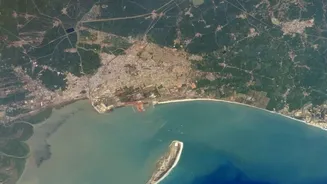
Andhra Pradesh Chief Minister N Chandrababu Naidu announced plans for a new spaceport at Hope Island on January 17, positioning it as part of the state’s proposed Space City initiative. The site is expected to primarily support private launch providers, adding to India’s expanding launch infrastructure.
With Chandrababu Naidu's announcement, India will have three spaceports. The existing Satish Dhawan Space Centre (SDSC-SHAR) at Sriharikota, the upcoming SSLV Launch Complex at Kulasekharapatnam, and now the proposed Hope Island facility.
The state government has not yet released timelines or technical specifications for the new spaceport.
A push towards private launches
Officials indicated that the Hope Island spaceport is being planned with commercial launches in mind. In recent years, India’s space ecosystem has seen increased participation from private companies developing small and medium-lift launch vehicles.
The new site is expected to complement ISRO’s existing facilities. SDSC-SHAR will continue to handle major national missions, while newer sites are being designed to handle specific orbital needs and smaller rockets.
Why location matters
Launch geography plays a role - a big one.
Earth rotates from west to east, and that motion provides a natural velocity boost to rockets launched eastward. At the equator, Earth’s surface moves at about 1,650 km/h (around 460 m/s). That speed drops steadily with latitude and reaches near zero at the poles.
Launch sites closer to the equator benefit from this rotation. Rockets begin their flight with built-in horizontal velocity, reducing fuel requirements. Polar orbit launches do not get this advantage, since the trajectory cuts across Earth’s rotation.
Limits of current launch paths
At present, launches into polar orbits from Sriharikota require a ‘dog-leg’ maneuvre to avoid flying over Sri Lanka. That adjustment costs energy. For larger vehicles like PSLV, GSLV, and LVM3, the loss is manageable. For smaller rockets, it is not.
Vehicles such as SSLV, Vikram-1, and Agnibaan are more sensitive to these penalties.
What comes next
To address this, ISRO is already building the SSLV launch complex at Kulasekharapatnam, expected to be ready by 2027. That facility will focus on polar orbit missions and support both ISRO and private players.
???? A Giant Leap for Andhra Pradesh in Space Technology! ????
Andhra Pradesh is set to script history as a Satellite Launching Facility will soon come up at Hope Island in Kakinada Bay, as announced by CM N. Chandrababu Naidu.
From being an industrial and port hub to now emerging… pic.twitter.com/NnMYWG85tS
— Andhra Community (@AndhraCommunity) January 18, 2026
With Chandrababu Naidu's announcement, India will have three spaceports. The existing Satish Dhawan Space Centre (SDSC-SHAR) at Sriharikota, the upcoming SSLV Launch Complex at Kulasekharapatnam, and now the proposed Hope Island facility.
The state government has not yet released timelines or technical specifications for the new spaceport.
A push towards private launches
Officials indicated that the Hope Island spaceport is being planned with commercial launches in mind. In recent years, India’s space ecosystem has seen increased participation from private companies developing small and medium-lift launch vehicles.
The new site is expected to complement ISRO’s existing facilities. SDSC-SHAR will continue to handle major national missions, while newer sites are being designed to handle specific orbital needs and smaller rockets.
Why location matters
Launch geography plays a role - a big one.
Earth rotates from west to east, and that motion provides a natural velocity boost to rockets launched eastward. At the equator, Earth’s surface moves at about 1,650 km/h (around 460 m/s). That speed drops steadily with latitude and reaches near zero at the poles.
????️ ???????????? ???????????????????????????????????? ???????????????????????????????????? ???????? ???????????????????????? ????????????????????????????!!
????
On 17 Jan, Andhra Pradesh CM Chandrababu Naidu announced a new spaceport in Hope Island as part of their Space City project. ✨️
This new launch site appears to be primarily aimed at… pic.twitter.com/MCXVWzQvKW
— ISRO Spaceflight (@ISROSpaceflight) January 19, 2026
Launch sites closer to the equator benefit from this rotation. Rockets begin their flight with built-in horizontal velocity, reducing fuel requirements. Polar orbit launches do not get this advantage, since the trajectory cuts across Earth’s rotation.
Limits of current launch paths
At present, launches into polar orbits from Sriharikota require a ‘dog-leg’ maneuvre to avoid flying over Sri Lanka. That adjustment costs energy. For larger vehicles like PSLV, GSLV, and LVM3, the loss is manageable. For smaller rockets, it is not.
Vehicles such as SSLV, Vikram-1, and Agnibaan are more sensitive to these penalties.
What comes next
To address this, ISRO is already building the SSLV launch complex at Kulasekharapatnam, expected to be ready by 2027. That facility will focus on polar orbit missions and support both ISRO and private players.