






What is the story about?
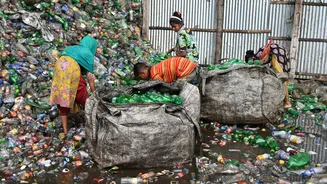
Delhi generates thousands of tonnes of garbage every day, with little of it being segregated at the source and nearly half of it ending up at the city’s already towering landfill sites.
Now, the national capital is looking to Indore, a city that transformed its waste-management system and became India’s cleanest, for a possible solution.
Lieutenant Governor Taranjit Singh Sandhu early this week directed the Municipal Corporation of Delhi (MCD) to examine the feasibility of piloting the Indore model in one municipal zone.
So, what exactly is the Indore model, how does it work, and can it help Delhi tackle its mounting garbage problem? Here’s all you need to know.
What is the Indore model?
The Indore model is an end-to-end waste-management system built around segregation at source, door-to-door collection, monitored transportation and scientific processing.
Source segregation means separating garbage where it is generated, that is, at homes, shops, restaurants or offices – and not after collection.
Indore requires residents and establishments to separate garbage into as many as six streams: wet, dry, plastic, sanitary, domestic hazardous and electronic waste. Garbage collection is also done with care to maintain segregation.
Indore began overhauling its system in 2016 and first topped the Centre’s Swachh Survekshan rankings in 2017. After holding the top position for several consecutive years, it entered the government’s “Super Swachh League” alongside Surat and Navi Mumbai in the 2024-25 rankings.
How does the system work?
Collection vehicles in Indore follow predetermined routes and carry separate compartments for different types of waste. The garbage is then transferred to processing facilities without mixing the segregated streams.
Wet or biodegradable waste, including food scraps and garden waste, is used for composting or biofuel production.
Dry waste is sorted at material recovery facilities, where recyclable material is separated and sent for recycling.
Domestic hazardous waste is handled and disposed of separately.
Large waste generators such as hotels, marriage halls and residential societies are also expected to process wet waste on their premises, while the civic body collects their dry waste separately.
The system is further strengthened by robust public-awareness campaigns, regular monitoring and penalties for non-compliance.
Why does Delhi want to adopt it?
Delhi’s immediate problem is not merely the enormous volume of garbage it produces but the amount reaching its dumpsites without being adequately segregated or processed. Its three major dumpsites are Ghazipur, Bhalswa and Okhla.
The MCD estimates that areas under its jurisdiction generate around 13,500 tonnes of waste daily.
When wet, dry and hazardous waste are mixed, recovering recyclable material becomes harder and a larger quantity must be dumped or subjected to centralised processing.
Sandhu warned that Delhi’s work to remove decades-old “legacy waste” from its landfills would be undermined if fresh garbage continued to accumulate at the same sites. He asked the MCD to establish a monitoring mechanism so that daily processing keeps pace with the volume of fresh waste received.
Will the model be implemented across Delhi?
Not immediately.
The L-G has asked the MCD to explore a pilot in one of its municipal zones. The zone, timeline and operational details have not yet been announced.
The pilot would test whether Indore’s practices, particularly household-level segregation, compartmentalised collection, route monitoring and separate processing, can operate effectively in Delhi’s much larger and more complex urban setting.
Its success will ultimately depend on more than copying Indore’s collection vehicles. Delhi would need sustained cooperation from residents, adequate processing capacity, consistent enforcement and safeguards to ensure segregated waste is not mixed after it leaves people’s homes.
Now, the national capital is looking to Indore, a city that transformed its waste-management system and became India’s cleanest, for a possible solution.
Lieutenant Governor Taranjit Singh Sandhu early this week directed the Municipal Corporation of Delhi (MCD) to examine the feasibility of piloting the Indore model in one municipal zone.
So, what exactly is the Indore model, how does it work, and can it help Delhi tackle its mounting garbage problem? Here’s all you need to know.
What is the Indore model?
The Indore model is an end-to-end waste-management system built around segregation at source, door-to-door collection, monitored transportation and scientific processing.
Source segregation means separating garbage where it is generated, that is, at homes, shops, restaurants or offices – and not after collection.
Indore requires residents and establishments to separate garbage into as many as six streams: wet, dry, plastic, sanitary, domestic hazardous and electronic waste. Garbage collection is also done with care to maintain segregation.
Indore began overhauling its system in 2016 and first topped the Centre’s Swachh Survekshan rankings in 2017. After holding the top position for several consecutive years, it entered the government’s “Super Swachh League” alongside Surat and Navi Mumbai in the 2024-25 rankings.
How does the system work?
Collection vehicles in Indore follow predetermined routes and carry separate compartments for different types of waste. The garbage is then transferred to processing facilities without mixing the segregated streams.
Wet or biodegradable waste, including food scraps and garden waste, is used for composting or biofuel production.
Dry waste is sorted at material recovery facilities, where recyclable material is separated and sent for recycling.
Domestic hazardous waste is handled and disposed of separately.
Large waste generators such as hotels, marriage halls and residential societies are also expected to process wet waste on their premises, while the civic body collects their dry waste separately.
The system is further strengthened by robust public-awareness campaigns, regular monitoring and penalties for non-compliance.
Why does Delhi want to adopt it?
Delhi’s immediate problem is not merely the enormous volume of garbage it produces but the amount reaching its dumpsites without being adequately segregated or processed. Its three major dumpsites are Ghazipur, Bhalswa and Okhla.
The MCD estimates that areas under its jurisdiction generate around 13,500 tonnes of waste daily.
When wet, dry and hazardous waste are mixed, recovering recyclable material becomes harder and a larger quantity must be dumped or subjected to centralised processing.
Sandhu warned that Delhi’s work to remove decades-old “legacy waste” from its landfills would be undermined if fresh garbage continued to accumulate at the same sites. He asked the MCD to establish a monitoring mechanism so that daily processing keeps pace with the volume of fresh waste received.
Will the model be implemented across Delhi?
Not immediately.
The L-G has asked the MCD to explore a pilot in one of its municipal zones. The zone, timeline and operational details have not yet been announced.
The pilot would test whether Indore’s practices, particularly household-level segregation, compartmentalised collection, route monitoring and separate processing, can operate effectively in Delhi’s much larger and more complex urban setting.
Its success will ultimately depend on more than copying Indore’s collection vehicles. Delhi would need sustained cooperation from residents, adequate processing capacity, consistent enforcement and safeguards to ensure segregated waste is not mixed after it leaves people’s homes.