







What is the story about?
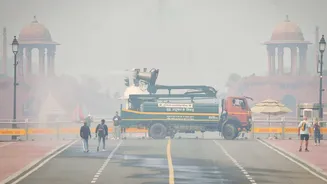
Amid deteriorating air quality in Delhi and neaby regions, the Delhi government has made 50% work from home mandatory in all government and private offices in the national capital. Only essential services like health, police, banking, etc are exempted from this.
In another major decision, state Cabinet Minister Kapil Mishra said ₹10,000 will transferred directly into the accounts of all registered and verified construction workers affected by the halt in construction work.
The Commission for Air Quality Management (CAQM) imposed GRAP-IV, including a ban on all construction and demolition activities in Delhi-NCR, after pollution levels rose sharply on December 13.
Stage IV of GRAP brings the strictest restrictions in Delhi-NCR. Under this stage, the entry of trucks into Delhi is stopped, except those carrying essential commodities or providing essential services. However, CNG, LNG, electric and BS-VI diesel trucks are allowed.
The plying of Delhi-registered diesel heavy goods vehicles (BS-IV and below) is banned, again with exceptions only for essential services.
All construction and demolition activities are banned, including even linear public projects such as highways, roads, flyovers, power transmission lines, pipelines and telecom works, which are otherwise allowed in lower stages.
Schools are required to run classes in a hybrid mode (online and physical) not only for primary students but also for higher classes (VI to IX and XI) in Delhi and the most affected NCR districts, with students given the option to attend online where feasible.
During winters, the Delhi-NCR region enforces restrictions under GRAP, which categorises air quality into four stages - Stage I (Poor, AQI 201-300), Stage II (Very Poor, AQI 301-400), Stage III (Severe, AQI 401-450), and Stage IV (Severe Plus, AQI above 450).
In another major decision, state Cabinet Minister Kapil Mishra said ₹10,000 will transferred directly into the accounts of all registered and verified construction workers affected by the halt in construction work.
पॉल्यूशन को देखते हुए दिल्ली सरकार के दो बड़े निर्णय : 1. निर्माण कार्य रुकने से प्रभावित सभी रजिस्टर्ड और वेरिफाइड निर्माण मजदूरों के खातों में ₹ 10,000
DBT होंगे 2. दिल्ली के सभी सरकारी व प्राइवेट दफ्तरों में 50% वर्क फ्रॉम होम मैंडेटरी, स्वास्थ्य जैसी आवश्यक सेवाओं के लिए… pic.twitter.com/Lh3DNeItdt
— Kapil Mishra (@KapilMishra_IND) December 17, 2025
The Commission for Air Quality Management (CAQM) imposed GRAP-IV, including a ban on all construction and demolition activities in Delhi-NCR, after pollution levels rose sharply on December 13.
Stage IV of GRAP brings the strictest restrictions in Delhi-NCR. Under this stage, the entry of trucks into Delhi is stopped, except those carrying essential commodities or providing essential services. However, CNG, LNG, electric and BS-VI diesel trucks are allowed.
The plying of Delhi-registered diesel heavy goods vehicles (BS-IV and below) is banned, again with exceptions only for essential services.
All construction and demolition activities are banned, including even linear public projects such as highways, roads, flyovers, power transmission lines, pipelines and telecom works, which are otherwise allowed in lower stages.
Schools are required to run classes in a hybrid mode (online and physical) not only for primary students but also for higher classes (VI to IX and XI) in Delhi and the most affected NCR districts, with students given the option to attend online where feasible.
During winters, the Delhi-NCR region enforces restrictions under GRAP, which categorises air quality into four stages - Stage I (Poor, AQI 201-300), Stage II (Very Poor, AQI 301-400), Stage III (Severe, AQI 401-450), and Stage IV (Severe Plus, AQI above 450).