


What is the story about?
Today, the Nawabs are gone, and so is their regal era. However, the mango-lore of the Nawabi period still lives on vibrantly in the words of the common people on the soil of Lalbagh, the erstwhile capital of Bengal, Bihar, and Odisha. Take the incident of Nawab Nazim Feradun Jah, for instance.
To secure the sapling of his favorite mango, the Nawab Nazim ultimately had to forge a matrimonial alliance with his own employee. The Nawab used to say that his daughter's dowry would not be paid in wealth or gold; instead, he would accept the sapling of that soul-pleasing mango tree as the dowry. He eventually collected it by marrying off his children, and that mango came to be known as 'Mirza Pasand'.
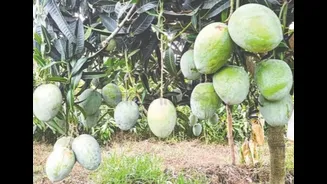
On one side stand Langra, Ranipasand, and Golapkhas. They are highly esteemed not only across Bengal but also outside. On the other side is one whose recognition is not as widespread, named Kohitur. Its home is Murshidabad. Yet, in the kingdom of mangoes, it is a Kohinoor.
Debates and arguments constantly rage between these two factions among mango experts. In these debates, stories of mango cultivation emerge, along with the context of turning mangoes into exclusive brands. Although neither the Nawabs nor the Nawabi era exists now, the 'Chhote Nawab' is still very much present in high spirits. The locals of Lalbagh know this cheerful octogenarian descendant of the Nawab family as 'Chhote Nawab', and he prefers it that way too.
He feels truly proud while narrating his ancestors' love for mangoes. Chhote Nawab says, "There was so much drama surrounding the Mirza Pasand mango tree! Today, that very tree is extinct. Through the efforts of the Nawabs, there were once 250 varieties of mangoes here. Now that number has dwindled to around a hundred. Nawab Wasif Ali Mirza’s highly favored Tota mango is also extinct today. Interestingly, a dispute between the Nawab and the British over the Tota mango had even escalated to the court."
Begum Raisunnesa, the wife of Nawab Humayun Jah, the creator of Hazarduari, owned a mango orchard spanning two and a half bighas. The orchard was named Raisbagh. In that Raisbagh stood Nawab Wasif Ali Mirza’s dearly loved Tota mango.
The Murshidabad Estate Manager leased Raisbagh to a local from Lalbagh named Gulubabu. Hearing this, the Nawab fumed with anger. A commission was formed to resolve the conflict between the Nawab and the British Raj's Board of Revenue. To the Nawab's disappointment, the commission's verdict went in favor of Gulubabu. Out of anger, grief, frustration, and insult, Nawab Syed Wasif Ali Mirza never touched the 'Tota mango' ever again, and today, there is no trace of that Tota mango either.
Several varieties of mangoes from Murshidabad district are on the verge of extinction. Although only a few Kohitur trees remain, currently a single piece of Kohitur mango sells for ₹500 to ₹600. Around a hundred varieties of mangoes like Himsagar, Gobindabhog, Madhuchur, Laxmanbhog, Rani, Bhavani, Golapkhas Bimli, Rawgni, Champa, Nawabpasand, Chandan Khosa, Bombay, Bira, Saranga, Pineapple, Ranipasand, Panjapasand, and Sindure still survive. Approximately 150 other varieties have become extinct. Despite approaching the government at various times, no Mango Emporium has been set up to preserve the endangered mango varieties.
The price of a single Kohitur mango can soar from ₹700-1000 rupees! While mangoes like Langra, Himsagar, Champa, Ranipasand, and Golapkhas sell in the retail markets of Murshidabad for ₹25-50 rupees per kg, Kohitur hardly ever reaches the local markets. Its arrival is directly destined for Kolkata.
Sandip Ghoshal, a mango expert from Murshidabad district, stated that history reveals that two hundred and fifty years ago, to judge the quality, enhance the excellence, and make ripe mangoes perfect for gourmets, a massive house was built in the Killa Nizamat area of Lalbagh. The house was named 'Amba Khana'. After plucking the mangoes from the trees using cotton-lined nets, they were brought to the Amba Khana by handlers wearing cotton gloves.
The Kohitur mango is extremely delicate and soft. Those tree-ripened mangoes used to be laid to rest on a bed of cotton. The mangoes kept on the cotton bed were gently turned from side to side every hour. This was mandatory, especially for the Kohitur mangoes. Then, when the right moment arrived, the skin was peeled using silver knives or bamboo strips, and the mango was served in slices. According to Baker Ali Mirza, a member of the Nawab family, "The mango, being the king of fruits, is highly sensitive. The slightest negligence can spoil its taste. Hence, such meticulous care."
Currently, there are mango orchards spanning about 23,000 hectares of land in Murshidabad district. Due to the lack of preservation centers or processing industries in this district, distress selling of mangoes is inevitable. There are also certain difficulties in exporting this district's mangoes abroad like Alphanso. Unlike Uttar Pradesh or Bihar, the climate of this district is not dry. The weather here is humid and hot.
Infestation of insects in mangoes is higher in this climate, requiring a greater application of pesticides. Furthermore, the shelf life of ripe mangoes in this district is short, and they rot quickly. Nonetheless, there are plans to export Laxmanbhog mangoes outside the state or the country this time.
A private organization, the 'Murshidabad Heritage Development Committee', has taken the initiative to export the delicious mangoes of this district to other states. "We once exported mangoes to Dubai. There is a huge demand for our country's mangoes in Middle Eastern countries, fetching a price of ₹400 per kg. Right now, the price of mangoes in the orchards of Murshidabad is ₹15–20 rupees per kg. To sell mangoes at ₹400 per kg abroad, eco-friendly mango cultivation must be practiced."
Varieties like Baishakhi Guti, Gopalbhog, Himsagar, Laxmanbhog, Langra, Fazli, Amrapali, and Mallika are being sold at ₹150-200 per kg. Additionally, Banganapalli mangoes are selling at ₹180-200 per kg. Golapkhas and Totapuri mangoes are fetching ₹150-160 per kg. The Miyazaki mango exhibits a ruby-red color, and its taste is intensely sweet. Once this mango touches the tongue, its flavor is remembered for a lifetime. However, the problem is that its price is so high that people cannot easily afford to buy and eat it. Consequently, because sales are low, the cultivation of this mango is also very limited. Apart from Japan, this mango is found in several places across Southeast Asia. Due to poor sales, farmers do not show much interest in cultivating this variety.
Among the famous mango varieties of Murshidabad, Rani, Bhavani, Champa, Bimli, Molamjam, Pineapple, Golapkhas, Shahdulla, Inayat Pasand, and Kohitur are significant. There are many folklores behind these names as well. The Champa mango is named so because its aroma resembles the Champa flower. Bimli was named after a maidservant who helped innovate this new variety. Molamjam tastes a lot like Langra but is even more balanced in flavor. Shahdulla is almost like Himsagar. The price of Himsagar is ₹80-90 per kg, while Champa stands at ₹120 per kg.
To secure the sapling of his favorite mango, the Nawab Nazim ultimately had to forge a matrimonial alliance with his own employee. The Nawab used to say that his daughter's dowry would not be paid in wealth or gold; instead, he would accept the sapling of that soul-pleasing mango tree as the dowry. He eventually collected it by marrying off his children, and that mango came to be known as 'Mirza Pasand'.
On one side stand Langra, Ranipasand, and Golapkhas. They are highly esteemed not only across Bengal but also outside. On the other side is one whose recognition is not as widespread, named Kohitur. Its home is Murshidabad. Yet, in the kingdom of mangoes, it is a Kohinoor.
Debates and arguments constantly rage between these two factions among mango experts. In these debates, stories of mango cultivation emerge, along with the context of turning mangoes into exclusive brands. Although neither the Nawabs nor the Nawabi era exists now, the 'Chhote Nawab' is still very much present in high spirits. The locals of Lalbagh know this cheerful octogenarian descendant of the Nawab family as 'Chhote Nawab', and he prefers it that way too.
He feels truly proud while narrating his ancestors' love for mangoes. Chhote Nawab says, "There was so much drama surrounding the Mirza Pasand mango tree! Today, that very tree is extinct. Through the efforts of the Nawabs, there were once 250 varieties of mangoes here. Now that number has dwindled to around a hundred. Nawab Wasif Ali Mirza’s highly favored Tota mango is also extinct today. Interestingly, a dispute between the Nawab and the British over the Tota mango had even escalated to the court."
Begum Raisunnesa, the wife of Nawab Humayun Jah, the creator of Hazarduari, owned a mango orchard spanning two and a half bighas. The orchard was named Raisbagh. In that Raisbagh stood Nawab Wasif Ali Mirza’s dearly loved Tota mango.
The Murshidabad Estate Manager leased Raisbagh to a local from Lalbagh named Gulubabu. Hearing this, the Nawab fumed with anger. A commission was formed to resolve the conflict between the Nawab and the British Raj's Board of Revenue. To the Nawab's disappointment, the commission's verdict went in favor of Gulubabu. Out of anger, grief, frustration, and insult, Nawab Syed Wasif Ali Mirza never touched the 'Tota mango' ever again, and today, there is no trace of that Tota mango either.
Several varieties of mangoes from Murshidabad district are on the verge of extinction. Although only a few Kohitur trees remain, currently a single piece of Kohitur mango sells for ₹500 to ₹600. Around a hundred varieties of mangoes like Himsagar, Gobindabhog, Madhuchur, Laxmanbhog, Rani, Bhavani, Golapkhas Bimli, Rawgni, Champa, Nawabpasand, Chandan Khosa, Bombay, Bira, Saranga, Pineapple, Ranipasand, Panjapasand, and Sindure still survive. Approximately 150 other varieties have become extinct. Despite approaching the government at various times, no Mango Emporium has been set up to preserve the endangered mango varieties.
The price of a single Kohitur mango can soar from ₹700-1000 rupees! While mangoes like Langra, Himsagar, Champa, Ranipasand, and Golapkhas sell in the retail markets of Murshidabad for ₹25-50 rupees per kg, Kohitur hardly ever reaches the local markets. Its arrival is directly destined for Kolkata.
Sandip Ghoshal, a mango expert from Murshidabad district, stated that history reveals that two hundred and fifty years ago, to judge the quality, enhance the excellence, and make ripe mangoes perfect for gourmets, a massive house was built in the Killa Nizamat area of Lalbagh. The house was named 'Amba Khana'. After plucking the mangoes from the trees using cotton-lined nets, they were brought to the Amba Khana by handlers wearing cotton gloves.
The Kohitur mango is extremely delicate and soft. Those tree-ripened mangoes used to be laid to rest on a bed of cotton. The mangoes kept on the cotton bed were gently turned from side to side every hour. This was mandatory, especially for the Kohitur mangoes. Then, when the right moment arrived, the skin was peeled using silver knives or bamboo strips, and the mango was served in slices. According to Baker Ali Mirza, a member of the Nawab family, "The mango, being the king of fruits, is highly sensitive. The slightest negligence can spoil its taste. Hence, such meticulous care."
Currently, there are mango orchards spanning about 23,000 hectares of land in Murshidabad district. Due to the lack of preservation centers or processing industries in this district, distress selling of mangoes is inevitable. There are also certain difficulties in exporting this district's mangoes abroad like Alphanso. Unlike Uttar Pradesh or Bihar, the climate of this district is not dry. The weather here is humid and hot.
Infestation of insects in mangoes is higher in this climate, requiring a greater application of pesticides. Furthermore, the shelf life of ripe mangoes in this district is short, and they rot quickly. Nonetheless, there are plans to export Laxmanbhog mangoes outside the state or the country this time.
A private organization, the 'Murshidabad Heritage Development Committee', has taken the initiative to export the delicious mangoes of this district to other states. "We once exported mangoes to Dubai. There is a huge demand for our country's mangoes in Middle Eastern countries, fetching a price of ₹400 per kg. Right now, the price of mangoes in the orchards of Murshidabad is ₹15–20 rupees per kg. To sell mangoes at ₹400 per kg abroad, eco-friendly mango cultivation must be practiced."
Varieties like Baishakhi Guti, Gopalbhog, Himsagar, Laxmanbhog, Langra, Fazli, Amrapali, and Mallika are being sold at ₹150-200 per kg. Additionally, Banganapalli mangoes are selling at ₹180-200 per kg. Golapkhas and Totapuri mangoes are fetching ₹150-160 per kg. The Miyazaki mango exhibits a ruby-red color, and its taste is intensely sweet. Once this mango touches the tongue, its flavor is remembered for a lifetime. However, the problem is that its price is so high that people cannot easily afford to buy and eat it. Consequently, because sales are low, the cultivation of this mango is also very limited. Apart from Japan, this mango is found in several places across Southeast Asia. Due to poor sales, farmers do not show much interest in cultivating this variety.
Among the famous mango varieties of Murshidabad, Rani, Bhavani, Champa, Bimli, Molamjam, Pineapple, Golapkhas, Shahdulla, Inayat Pasand, and Kohitur are significant. There are many folklores behind these names as well. The Champa mango is named so because its aroma resembles the Champa flower. Bimli was named after a maidservant who helped innovate this new variety. Molamjam tastes a lot like Langra but is even more balanced in flavor. Shahdulla is almost like Himsagar. The price of Himsagar is ₹80-90 per kg, while Champa stands at ₹120 per kg.