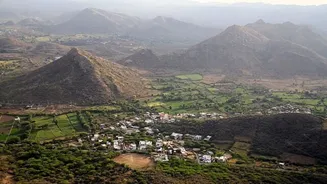

The Union Ministry of Environment, Forest and Climate Change (MoEF&CC) has directed states to impose a complete ban on the grant of new mining leases across
the entire Aravalli range, stretching from Delhi to Gujarat, in a move aimed at curbing illegal and unregulated mining.
The directions are in line with and reiterate the Supreme Court’s order, under which no new mining licences are to be granted in the Aravalli region until a comprehensive, science-based management plan for sustainable mining (MPSM) is prepared.
The prohibition applies uniformly across the Aravalli landscape and is intended to preserve the geological and ecological integrity of the range as a continuous ridge extending from Gujarat to the National Capital Region. The ministry said the directions are meant to stop unregulated mining and safeguard environmentally sensitive areas.
Also Read: Aravallis remain fully protected; move targets illegal mining only: Bhupender Yadav
The MoEF&CC has tasked the Indian Council of Forestry Research and Education (ICFRE) with identifying further zones across the Aravallis where mining should be prohibited, beyond areas already barred by the Centre. This identification will be based on ecological, geological and landscape-level considerations.
ICFRE has also been directed to prepare the MPSM for the entire Aravalli region. The plan will assess cumulative environmental impacts and ecological carrying capacity, identify conservation-critical zones, and outline measures for restoration and rehabilitation.
The ministry said the plan will be placed in the public domain for stakeholder consultation.
For mines already in operation, states have been instructed to ensure strict compliance with environmental safeguards and Supreme Court orders, with tighter regulation to enforce sustainable mining practices.
Also Read: SC’s new Aravalli definition opens loopholes for mining, strips vast areas of protection: Legal experts
The Centre reiterated its commitment to the long-term protection of the Aravalli ecosystem, citing its role in preventing desertification, conserving biodiversity, recharging aquifers and providing critical environmental services to the region.