








There is an urgent need to widen pension fund investments, revisit the tax treatment of bonds, reduce government ownership in banks and stop using banks for
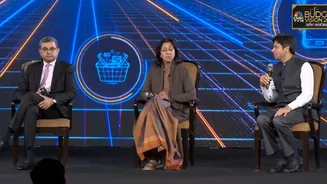
quasi-fiscal purposes, Naina Lal Kidwai, former FICCI President and Chairperson, Rothschild & Co. (India), said while addressing a CNBC TV18 session on expectations from the upcoming Union Budget.
The CNBC TV18 discussion brought together Anant Goenka, President of FICCI and Vice Chairman of RPG Group; Shubhrakant Panda, former President of FICCI and Managing Director of Indian Metals & Ferro Alloys Ltd.; and Naina Lal Kidwai to outline industry expectations for the forthcoming Budget.
The conversation centred on key themes including the outlook for private capital expenditure and manufacturing, the need to leverage exports and free trade agreements amid a weakening rupee, the challenge of job creation in an increasingly automated economy, the role of infrastructure spending and asset monetisation, and the importance of financial-sector reforms. Speakers also underscored the government’s commitment to fiscal prudence and the need to move towards the next phase of structural reforms.
Manufacturing and private investment
On manufacturing and private investment, Anant Goenka said industry is looking for a continued push for manufacturing in the Budget, in line with the Economic Survey’s emphasis on manufacturing and exports. He noted that FICCI has consistently advocated a higher defence outlay, including increased investment in defence manufacturing and higher allocations for research and development. Goenka also flagged electronics manufacturing services (EMS) and the development of mega industrial parks as priority areas where targeted policy support could strengthen India’s manufacturing ecosystem. On the investment cycle, he said there is “a clear desire towards increase in private capex”, pointing out that capacity utilisation has risen from around 75% to over 85%, a level that typically triggers fresh private investment.
Private investment momentum
On private investment momentum and fiscal discipline, Shubhrakant Panda said the general consensus within industry is that private investment gathers momentum once capacity utilisation crosses the 80% mark. He added that the government’s adherence to fiscal discipline has helped build confidence, noting that the finance minister has “done a great job of not compromising on fiscal prudence”, thereby providing a stable macroeconomic environment for long-term investment decisions.
Exports, competitiveness and the rupee
On exports, competitiveness and the rupee, Goenka said the recent depreciation of the rupee should be viewed as an opportunity rather than a concern. He argued that India needs to be “more globally focussed” and take advantage of currency movements to become more competitive internationally. According to him, the rupee’s fall can be effectively leveraged by combining it with India’s network of free trade agreements. Goenka also highlighted the complementarity between advanced markets such as Europe and developing economies like India, suggesting that Indian industry should position itself to capitalise on these linkages. Reinforcing this point, Panda said the private sector must orient itself towards global competitiveness and act decisively on opportunities created by FTAs.
On jobs and employment, Naina Lal Kidwai said job creation remains the single biggest concern for industry, citing a FICCI survey in which over 70% of CEOs accorded the highest priority to employment generation. While welcoming the concept of internship and apprenticeship schemes, she said these programmes are not working effectively due to “not enough incentive for industry” and are often viewed as a compliance burden. Kidwai stressed that skills-based training is critical, particularly at a time when automation is rising. “With every rupee of capex spend we are seeing lower jobs,” she said, noting that industry increasingly opts for robotics. She also pointed to proposals such as a youth service programme to assist in public services as a way to combine training with employment.
Infrastructure and sectoral reforms
On infrastructure and sectoral reforms, Kidwai said she hopes for a continued focus on infrastructure in the Budget, but cautioned that spending alone will not suffice. India, she said, continues to lag in attracting international visitors, and while infrastructure helps, much more needs to be done, including establishing a national framework to remove policy ambiguity and avoid unit-level litigation. Panda added that infrastructure spending as a percentage of GDP has largely peaked, but as the economy grows, even a stable ratio translates into a larger absolute outlay. He said the emphasis should now be on creating an ecosystem that enables manufacturing to move up the value chain, while cautioning that production-linked incentive schemes cannot be a panacea and must be balanced with broader reforms.
Financial-sector reform
On financial-sector reform and macroeconomic stability, Kidwai reiterated that forex management cannot be sustained indefinitely through intervention alone. She said the RBI’s policy of managing volatility is appropriate, but stressed the need to focus on macroeconomic robustness and strengthening forex earnings through exports. On infrastructure financing, she added that while infrastructure spending stands at around 3.1% of GDP, it can be made to “work harder” through platforms such as InvITs.
Overall, the session reflected industry’s expectation that the upcoming Budget should strike a balance between growth, jobs and competitiveness, while maintaining fiscal discipline and advancing deeper structural reforms.