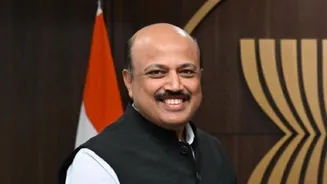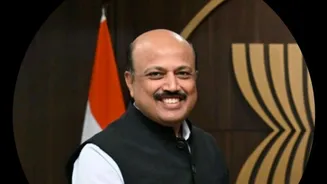

“Some of these deals may be finalised this year,” Agrawal told CNBC-TV18, adding that Canada also wants to resume negotiations and that India is considering it.
The comment sets the tone for India’s current trade strategy: widen the funnel, close where there is convergence, and move fast where momentum exists.
“Wherever we find mutual convergence, we will try to go ahead,” Agrawal said, noting that a major part of negotiations have progressed after the conclusion of the India-EU free trade agreement.
4 FTAs, 30 countries
Agrawal said India has concluded four FTAs covering 30 countries. Once these agreements are operationalised, Indian exports will get preferential access to 55–60% of the global market, he said.
The scale matters. “It’s a year of global turmoil,” Agrawal said, even as India’s economic growth remains around 7%. Despite the turbulence, exports have grown in the first nine months of the financial year, helped by diversification and what he described as “creating a wider and fertile ground to make sustained growth in exports.”
The opportunity, according to him, lies not just in goods but increasingly in services. All 32 European economies are services-driven, he pointed out, with the UK deriving nearly 70% of its GDP from services. India, he said, expects $5 trillion of the $8 trillion global services market to be covered under its FTAs.
On the India-EU trade deal, Agrawal highlighted cooperation beyond tariffs, pointing to high-tech collaboration with the EU and agritech cooperation with New Zealand under other FTAs. He also underlined that services commitments under these agreements are designed with the long term in mind, aligning with India’s broader goal for the services sector leading up to 2047. It is pertinent to note that services constitute about 54–55% of India’s total GDP.
India-US trade talks: engagement, not a date
On India-US trade negotiations, Agrawal struck a careful note. “We remain positively engaged,” he said, adding that two frameworks are still in place. The US, he noted, is a large economy and a comprehensive FTA “will take time”.
No fresh timeline was announced.
“How fast it will happen—we hope to get it sooner than later, but we can’t put a date,” Agrawal said. He acknowledged that reciprocal tariffs are largely in the goods space and stressed that India is looking for a more balanced trade outcome. “Trying to see that both sides are better off,” he said, adding that any deal would require commitments from both sides.
Exports, imports and the deficit math
Agrawal said India is looking to cross $850 billion in exports this year, with a sharper rise expected once FTAs come into force. Labour-intensive sectors remain under stress due to global turmoil, he said, but textiles and marine exports have grown till December, aided by diversification.
On imports, he flagged energy, gold and silver as the “two biggest elephants in the import room.” India, he said, imports a lot of energy and is focused on maintaining a diversified supply chain.
The trade deficit, according to him, is not expected to widen sharply. “Trade deficit won’t go up more than $15–20 billion by the end of the year,” Agrawal said.
Budget 2026’s trade-side tailwinds
The Budget adds trade-side tailwinds across sectors. On SEZs, commerce secretary Rajesh Agrawal said the scheme is being recalibrated to reflect changing global trade realities, with plans to allow local market access while safeguarding the domestic industry. Idle SEZ capacity could be used to substitute imports and push value-added exports, aided by a one-time window next fiscal.
For textiles, the Export Promotion Mission outlines 11 components, with guidelines rolling out in phases, helping MSMEs integrate into export supply chains. PLI schemes, he said, offset structural handicaps.
On manufacturing aspirations to be 25% of the GDP, he added that 200 legacy clusters will be rejuvenated. On CBAM, Agrawal said India won’t be worse off, with carbon markets helping avoid double levies.