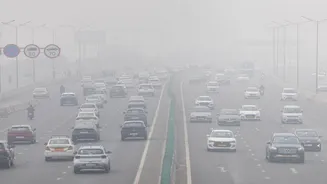

Clear skies in Delhi NCR continue to be an aberration as the Air Quality Index continues to remain a pain for residents now breathing in a literal gas-chamber since the past three months now. All visitors to India's national capital are greeted by blanked out air-monitoring stations, masked citizens, and a pall of smog, which is now an unwanted companion for all Delhiites.
Anti-pollution curbs via GRAP restrictions have been imposed by the Centre for Air Quality Management in Delhi NCR. Dissecting the air pollution matrix, the Centre for Air Quality Management (CAQM) had recently told the Supreme Court that the transport sector contributes to 41% of the air pollution load, followed by 21% from dust and construction, 19% due to industry, and 5% due to power plants. The top court had also flagged continuing use of diesel-guzzling cars, generators, and other polluting gadgets among reasons behind air quality.
Beyond the often discussed sources of air pollution, cigarette smoke was flagged as a major contributor to air pollution as per a report by the Central Pollution Control Board (CPCB) in 2024, due to release of harmful particulate matter and toxic gases, with studies indicating that cigarette smoke emits 10 times more particulate matter than a diesel car.
While stubble burning at its yearly peak may be described a large culprit behind air pollution, here's an interesting excerpt from an observation made by the National Green Tribunal in 2024: "A study had estimated that coal-fired thermal power plants in the NCR released a staggering 281 kilotons of sulphur dioxide (SO₂) annually. In comparison, crop burning, which is often cited as a major source of pollution, emitted 17.8 kilotons of SO₂ from the burning of 8.9 million tons of crop stubble"
Also Read: Adani Power's ₹4,000-crore resolution plan for Vidarbha Industries upheld by NCLAT
Responding to recent reports calling for installation of Flue-gas desulphurisation (FGD) devices in thermal power plants for reduction in air pollution levels, Power Minister Manohar Lal Khattar has said that FGD devices at govt-owned thermal power plants would've meant ₹80,000 crores in expenses. Stating that a stakeholder meeting was called to discuss the issue as different reports had given varying indications, he indicated that most stakeholders in the meeting said that FGD devices wouldn't have made much of a difference as sulphur emissions are too miniscule. While he pointed out that removal of a legal mandate for FGD devices at all power plants may have prompted intervention by courts, he added that a middle path was suggested, which meant installation of FGD devices at some thermal power plants at the cost of ₹10,000 crores to ₹12,000 crores.
The way ahead
Desperate times, desperate measures. An IIT Kanpur study in 2016 had found that tandoors contribute to nearly 10% of total suspended particulate matter. While the CAQM last year had curbed the use of Coal-fired tandoors to cut particulate emissions, it has given more suggestions to the Supreme Court for implementation. These include phase-out of polluting vehicles, stricter green norms, and elimination of use of coal in industries and closure of thermal plants within 300 kms of the national capital.
While thermal plants like Rajghat and Badarpur in Delhi and another one in Faridabad have been closed down over the past decade due to air pollution, 12 thermal power plants within 300 kms of the national capital remain essential to provide round-the-clock power supply as renewable energy covers nearly 33% of power demand, and remains subject to weather, availability of sunshine, and a regular supply of biomass.
A former Power Secretary said that with lifestyles dominated by the use of electrical and electronic appliances, a power cut won't just mean disruption but also more pollution through crude gensets, many of which don't even use pollution control devices. However, he suggested that carbon emissions from sources like coal plants, stubble burning or garbage burning can be nullified via use of waste-to-energy and other renewable power technologies.
While India's renewable energy capacity has grown nearly 6 times from 35 GW in 2014 to over 200 GW in 2025; the real power produced is determined by the Plant Load Factor (PLF) of a power installation: which is the percentage of power actually produced from an installed capacity. The PLF of thermal power plants is over 70%, compared to around 25% for solar and wind energy installations. Apart from irregularity and cyclical nature of power supply, the rise of renewable energy installations is hamstrung by concerns on availability of transmission, storage, and space for big solar and wind installations.
India's peak power demand has risen from 136 GW in 2013-14 to around 250 GW in 2025, and with an average growth rate of 5.6%. Peak power demand is expected to cross 335 GW by FY 2030. Though government aims to install renewable energy capacity of 500 GW by 2030, increased in industrialisation, per capita incomes, EVs and the power-intensive data centres will mean a significant jump in power demand, which may even cross all current estimates.
Also, lower PLF for solar and wind energy will imply an increased dependence on thermal power, which is also reflected in government policy. India is aiming for 80 GW more of thermal power capacity to add to the 240 GW thermal power capacity in June 2025.
Also Read: Deposit growth is lagging credit growth and RBI must do more on liquidity, warns Axis Bank CEO
The way ahead, as per policymakers and experts alike, is to scale up a bouquet of renewable energy projects and battery storage for future to provide certainty of power supply for a long-term move away from thermal power plants. The bouquet will include solar power, wind energy, and Green Hydrogen, which are already being promoted by the government. Hydel projects, which have an estimated potential of 133 GW, may witness a policy push soon with the government coming up with a scheme for small hydel projects. Geothermal energy, nuclear power, and waste to energy initiatives can also be looked at for a further push for non-fossil driven energy.