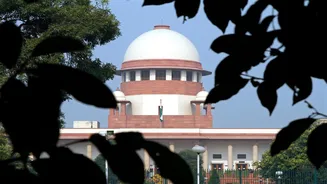

A vacation Bench comprising Chief Justice of India Surya Kant, Justice J K Maheshwari and Justice A G Masih is scheduled to consider the matter on Monday, December 29.
The court’s intervention follows sustained protests by environmental groups and opposition parties across multiple states after the Supreme Court, on November 20, accepted the recommendations of a central government committee that redefined what qualifies as an Aravalli hill.
Under the revised framework, only landforms with an elevation of 100 metres or more above local relief are classified as Aravalli Hills, while an Aravalli range is defined as a cluster of two or more such hills located within 500 metres of each other. Critics argue that the narrower definition weakens long-standing ecological safeguards for the fragile mountain system.
Senior legal experts had earlier warned that the revised definition could strip vast tracts of the Aravallis of protection . Senior advocate Dushyant Dave described the move as deeply troubling, cautioning that it fundamentally misunderstands the nature of a mountain range and exposes large areas to commercial exploitation, including mining.
The committee that proposed the new definition was led by the Union environment ministry and included representatives from Gujarat, Haryana, Rajasthan and Delhi, along with the Geological Survey of India and the Forest Survey of India. Environmentalists contend that an earlier, broader definition submitted by the Forest Survey of India in 2010 — and accepted by the Supreme Court at the time — better reflected the contiguous slopes, foothills and buffer zones of the Aravalli system.
Activists have warned that only a small fraction of existing Aravalli landforms may qualify for protection under the revised criteria, potentially leaving large portions of the range across four states outside regulatory oversight, with implications for groundwater recharge, climate moderation and desertification.