







What is the story about?
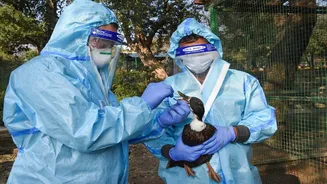
One of the worst worries for epidemiologists is that the bird flu virus, which is rampaging across poultry farms around the world, could spread to human hosts. Scientists have long cautioned that bird flu, often known as H5N1, may eventually spread dangerously from birds to people and cause a worldwide health emergency.
Now, Indian scientists have utilised an advanced Artificial Intelligence (AI)-based model to predict and map the potential spillover of the H5N1 bird flu virus into human populations.
Researchers Philip Cherian and Gautam Menon from Ashoka University published a peer-reviewed study in BMC Public Health titled "Modelling a potential zoonotic spillover event of H5N1 influenza." The model simulates how an H5N1 virus could unfold in humans and what early interventions could stop it.
In a conversation with the BBC, Prof Menon said, “The threat of an H5N1 pandemic in humans is a genuine one, but we can hope to forestall it through better surveillance and a more nimble public-health response.”
In the study, the team used BharatSim -- an agent-based simulation framework for infectious diseases -- to describe the sequential stages of a zoonotic spillover.
“We modelled the possibility of initial spillover events of H5N1 from birds to humans, followed by sustained human-to-human transmission. Our model describes the two-step nature of outbreak initiation, showing how crucial epidemiological parameters governing transmission can be calibrated given data for the distribution of the number of primary and secondary cases at early times,” the researchers wrote in the paper.
Avian flu - a type of influenza - has occasionally infected humans since originating in China in the late 1990s. It is widespread in South and Southeast Asia due to the world's fastest-growing poultry markets. The World Health Organization (WHO) reported 990 human H5N1 infections in 25 countries between 2003 and August 2025, with 475 deaths, representing a 48% fatality rate.
Culling birds is effective in preventing spillover into the human population, provided it is done early, before a primary human infection has occurred. The earlier the culling, the higher the probability of preventing a spillover, the study noted.
"Our simulations account for different interventions. These include (i) the culling of all birds in the farm, (ii) the quarantining of primary and secondary contacts once a threshold of cases is crossed, and (iii) a vaccination drive where primary and secondary contacts are targeted. We find that culling birds is effective, provided no primary infection has occurred," it read.
The experts underlined that control efforts are most effective in the early phases of an outbreak. “Once community transmission takes over, cruder public-health measures such as lockdowns, compulsory masking, and large-scale vaccination drives are the only options left. At this stage, the large number of cases ensures that stochastic effects should play a smaller role and conventional compartmental models should provide appropriate guidance,” they said.
The study demonstrates how such models enable systematic real-time assessment of policy options that could limit disease spread while also guiding a better knowledge of disease epidemiology for an emergent disease.
According to the Cleveland Clinic, symptoms of Avian influenza include fever, cough, body aches, fatigue, muscle aches, sore throat and conjunctivitis.
Now, Indian scientists have utilised an advanced Artificial Intelligence (AI)-based model to predict and map the potential spillover of the H5N1 bird flu virus into human populations.
Researchers Philip Cherian and Gautam Menon from Ashoka University published a peer-reviewed study in BMC Public Health titled "Modelling a potential zoonotic spillover event of H5N1 influenza." The model simulates how an H5N1 virus could unfold in humans and what early interventions could stop it.
In a conversation with the BBC, Prof Menon said, “The threat of an H5N1 pandemic in humans is a genuine one, but we can hope to forestall it through better surveillance and a more nimble public-health response.”
In the study, the team used BharatSim -- an agent-based simulation framework for infectious diseases -- to describe the sequential stages of a zoonotic spillover.
“We modelled the possibility of initial spillover events of H5N1 from birds to humans, followed by sustained human-to-human transmission. Our model describes the two-step nature of outbreak initiation, showing how crucial epidemiological parameters governing transmission can be calibrated given data for the distribution of the number of primary and secondary cases at early times,” the researchers wrote in the paper.
Avian flu - a type of influenza - has occasionally infected humans since originating in China in the late 1990s. It is widespread in South and Southeast Asia due to the world's fastest-growing poultry markets. The World Health Organization (WHO) reported 990 human H5N1 infections in 25 countries between 2003 and August 2025, with 475 deaths, representing a 48% fatality rate.
Culling birds is effective in preventing spillover into the human population, provided it is done early, before a primary human infection has occurred. The earlier the culling, the higher the probability of preventing a spillover, the study noted.
"Our simulations account for different interventions. These include (i) the culling of all birds in the farm, (ii) the quarantining of primary and secondary contacts once a threshold of cases is crossed, and (iii) a vaccination drive where primary and secondary contacts are targeted. We find that culling birds is effective, provided no primary infection has occurred," it read.
The experts underlined that control efforts are most effective in the early phases of an outbreak. “Once community transmission takes over, cruder public-health measures such as lockdowns, compulsory masking, and large-scale vaccination drives are the only options left. At this stage, the large number of cases ensures that stochastic effects should play a smaller role and conventional compartmental models should provide appropriate guidance,” they said.
The study demonstrates how such models enable systematic real-time assessment of policy options that could limit disease spread while also guiding a better knowledge of disease epidemiology for an emergent disease.
According to the Cleveland Clinic, symptoms of Avian influenza include fever, cough, body aches, fatigue, muscle aches, sore throat and conjunctivitis.