



What is the story about?
Artificial Intelligence is moving beyond screens and into workshops. That shift was visible at the India AI Impact Summit 2026 in New Delhi, where Tata Consultancy Services (TCS) demonstrated how AI can be used inside a traditional Kanjivaram weaving setup.
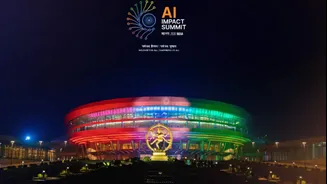
The summit, held at Bharat Mandapam, focused on practical uses of AI. One of the most discussed exhibits was a working loom.
India AI Impact Summit 2026: What TCS showcased and how it works
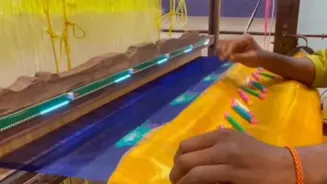
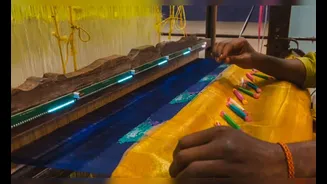
In a video shared from the event, a Kanjivaram weaver sat at a loom fitted with LED indicators. The lights signalled which thread colour to pick and when. The pattern itself was not drawn manually. It was generated using the TCS Intelligent Design Platform.
The system accepts voice inputs, hand-drawn sketches or reference images. It then converts them into what TCS describes as ‘loom-ready’ designs. The output can be previewed in 3D. There is also an Augmented Reality view that shows how the sari will look before weaving begins. Design selection, which traditionally takes days or weeks, can now be done in minutes.
Why AI in Handloom matters for India’s textile sector
That change matters. According to figures cited by NDTV, up to 40% of finished products in parts of the handloom sector are returned because of mismatched designs or execution errors. Reworking a sari is costly and time-consuming. But AI changes that.
Reducing error on the loom with smart weaver assist
Alongside the design software, TCS introduced what it calls Smart Weaver Assist. The LED system guides thread movement in real time. Less-experienced weavers can follow complex patterns without memorising long sequences.
The aim is not to replace artisans, but to bridge the skill gap between senior weavers and new entrants. India’s handloom industry supports millions of families, yet younger workers often hesitate to enter the trade due to its complexity and long training cycle. With guided assistance, the learning curve may shorten.
Broader message from the summit
The IndiaAI Impact Summit 2026 featured several other applications of Artificial Intelligence, from transport safety systems to tools that reduce manual error in industrial settings. The focus remained on physical-world use cases rather than consumer chatbots or virtual tools.
The sari demonstration stood out because it combined heritage craft with digital infrastructure. The message at Bharat Mandapam was clear - AI is being positioned not only as software, but as support for traditional industries where precision and time still determine income.
The summit, held at Bharat Mandapam, focused on practical uses of AI. One of the most discussed exhibits was a working loom.
India AI Impact Summit 2026: What TCS showcased and how it works
In a video shared from the event, a Kanjivaram weaver sat at a loom fitted with LED indicators. The lights signalled which thread colour to pick and when. The pattern itself was not drawn manually. It was generated using the TCS Intelligent Design Platform.
The system accepts voice inputs, hand-drawn sketches or reference images. It then converts them into what TCS describes as ‘loom-ready’ designs. The output can be previewed in 3D. There is also an Augmented Reality view that shows how the sari will look before weaving begins. Design selection, which traditionally takes days or weeks, can now be done in minutes.
Why AI in Handloom matters for India’s textile sector
That change matters. According to figures cited by NDTV, up to 40% of finished products in parts of the handloom sector are returned because of mismatched designs or execution errors. Reworking a sari is costly and time-consuming. But AI changes that.
Reducing error on the loom with smart weaver assist
Alongside the design software, TCS introduced what it calls Smart Weaver Assist. The LED system guides thread movement in real time. Less-experienced weavers can follow complex patterns without memorising long sequences.
The aim is not to replace artisans, but to bridge the skill gap between senior weavers and new entrants. India’s handloom industry supports millions of families, yet younger workers often hesitate to enter the trade due to its complexity and long training cycle. With guided assistance, the learning curve may shorten.
Broader message from the summit
The IndiaAI Impact Summit 2026 featured several other applications of Artificial Intelligence, from transport safety systems to tools that reduce manual error in industrial settings. The focus remained on physical-world use cases rather than consumer chatbots or virtual tools.
The sari demonstration stood out because it combined heritage craft with digital infrastructure. The message at Bharat Mandapam was clear - AI is being positioned not only as software, but as support for traditional industries where precision and time still determine income.