








What is the story about?
The Supreme Court on Monday, December 29, kept the new definition of the Aravalli Hills in abeyance until it is reviewed again. The matter was posted for hearing to January 21, 2026.
A special vacation bench of CJI Surya Kant and Justices JK Maheshwari and AG Masih issued notices to the Union and state governments in the matter.
"We propose high powered committee to consider the reports submitted by previous committee for holistic examination of issues," CJI Kant said.
The committee's mandate would be detailed identification of areas that would be excluded from the protection, and the analysis whether regulatory mining would result in ecological damage, the bench said.
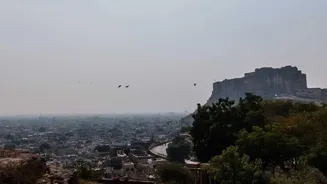
The apex court had taken a suo motu cognisance of the issue as acceptance of new definition of Aravalli Hills and Aravalli Range led to rise in concerns of its environmental damage and rampant mining activities.
Aravalli Hills definition
The Supreme Court, on November 20, had accepted the definition recommended by a central committee. According to the new definitions, Aravalli Hills is defined as any landform located in the Aravalli districts, "having an elevation of 100 metres or more from the local relief."
On the other hand, Aravalli Range is defined as "two or more Aravali Hills, located within the proximity of 500 m from each other, measured from the outermost point on the boundary of the lowest contour line on either side."
The entire area of landforms falling between the lowest contour lines of these Hills, along with associated features such as Hills, Hillocks, supporting slopes, etc., shall also be included as part of Aravali Range.
Centre clarifies no mining allowed
Solicitor General Tushar Mehta, appearing for the central government, said that the government has issued directions to the states to ensure that no fresh mining licences are issued.
The court noted that there is a need for clarification on whether restrictive demarcation has created the concept of non-Aravalli areas, thereby allowing rampant mining in areas excluded under the definition.
The bench said that it must be clarified if regulatory mining would be allowed in the gaps or not, adding that there is a need to ensure that ecological continuity is not compromised, and for that exhaustive, and scientific determination is required.
A special vacation bench of CJI Surya Kant and Justices JK Maheshwari and AG Masih issued notices to the Union and state governments in the matter.
"We propose high powered committee to consider the reports submitted by previous committee for holistic examination of issues," CJI Kant said.
The committee's mandate would be detailed identification of areas that would be excluded from the protection, and the analysis whether regulatory mining would result in ecological damage, the bench said.
The apex court had taken a suo motu cognisance of the issue as acceptance of new definition of Aravalli Hills and Aravalli Range led to rise in concerns of its environmental damage and rampant mining activities.
Aravalli Hills definition
The Supreme Court, on November 20, had accepted the definition recommended by a central committee. According to the new definitions, Aravalli Hills is defined as any landform located in the Aravalli districts, "having an elevation of 100 metres or more from the local relief."
On the other hand, Aravalli Range is defined as "two or more Aravali Hills, located within the proximity of 500 m from each other, measured from the outermost point on the boundary of the lowest contour line on either side."
The entire area of landforms falling between the lowest contour lines of these Hills, along with associated features such as Hills, Hillocks, supporting slopes, etc., shall also be included as part of Aravali Range.
Centre clarifies no mining allowed
Solicitor General Tushar Mehta, appearing for the central government, said that the government has issued directions to the states to ensure that no fresh mining licences are issued.
The court noted that there is a need for clarification on whether restrictive demarcation has created the concept of non-Aravalli areas, thereby allowing rampant mining in areas excluded under the definition.
The bench said that it must be clarified if regulatory mining would be allowed in the gaps or not, adding that there is a need to ensure that ecological continuity is not compromised, and for that exhaustive, and scientific determination is required.