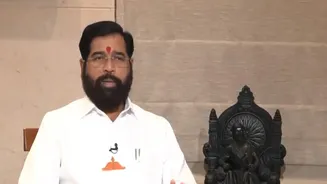

The battle for the Mumbai mayor’s post has intensified after the Brihanmumbai Municipal Corporation (BMC) election results, with Maharashtra Deputy Chief
Minister Eknath Shinde shifting all councillors of his Shiv Sena faction to a five-star hotel, triggering speculation of high-stakes political manoeuvring within the ruling Mahayuti alliance.
Soon after the results were declared on January 16, Shinde moved his party’s 29 newly elected corporators to a luxury hotel in Bandra. While party sources said the move was meant to prevent poaching and allow councillors to rest after the polls, political observers see it as a pressure tactic aimed at strengthening Shinde’s bargaining position in mayoral negotiations—particularly vis-à-vis alliance partner BJP.
The BJP has emerged as the single largest party in the 227-member BMC, winning 89 seats, but remains short of the 114-seat majority required to form the civic body on its own. With Shinde’s Shiv Sena holding 29 seats, the Mahayuti alliance’s tally rises to 118, giving Shinde a decisive role in determining who occupies the powerful mayor’s post.
Opposition parties together have close to 100 seats, but remain fragmented. Shiv Sena (UBT) won 65 seats, Congress secured 24, while the Maharashtra Navnirman Sena (MNS) won six wards.
Political analysts say Shinde is keen to leverage the BJP’s dependence on his support to secure the mayor’s post for his faction, or at least push for a rotational arrangement. According to sources, Shinde’s party has proposed a “two-and-a-half-year formula” for the mayor’s term, similar to power-sharing arrangements seen earlier in Maharashtra politics.
Some analysts also link Shinde’s assertiveness to the outcome of the recent Maharashtra Assembly elections, where, despite the Mahayuti contesting under his leadership, the chief minister’s post went to BJP leader Devendra Fadnavis after the results. Shinde and NCP’s Ajit Pawar were appointed deputy chief ministers. Observers believe the BMC mayoral contest offers Shinde an opportunity to reassert his political standing.
The BMC, India’s richest civic body, commands a budget comparable to that of several smaller states, making control of the mayor’s office politically significant. The undivided Shiv Sena had dominated the BMC for decades, and Shinde is keen to demonstrate that his faction represents the party’s legacy.
Shinde’s move has drawn sharp criticism from Shiv Sena (UBT) chief Uddhav Thackeray, who accused both the BJP and the Shinde faction of playing “hotel politics.” Thackeray claimed that Shinde fears defections within his own ranks and alleged that the BJP could still bypass Shinde to appoint its own mayor. “We have not lost. We fought the defectors, and if God wills, the mayor will be ours,” Thackeray said.
Meanwhile, Chief Minister Devendra Fadnavis has sought to play down the controversy, stating that discussions on the mayor’s post, its tenure and power-sharing arrangements will be held with Shinde and that there is “no dispute” within the alliance.
With the mayoral election due shortly and councillor voting crucial, all eyes are now on coalition negotiations, as Shinde’s Shiv Sena—despite having fewer seats—emerges as the key kingmaker in Mumbai’s civic power struggle.
Also Read: US Ambassador Sergio Gor kicks off first Mumbai visit; meets RBI Governor, Tata Sons Chairman and CM Fadnavis