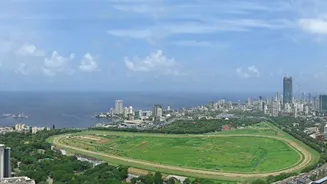

According to the plan, 125 acres will be carved out of the Mahalaxmi Racecourse, while the remaining 170 acres will come from land reclaimed for the coastal road. The park will be connected via an underpass to Annie Besant Road near Haji Ali. The racing track and stables at the racecourse will remain untouched, and horse racing activities will continue as before.
"There will be no concrete construction on the surface of this park. The central park will be directly connected to the coastal road through an underground passage. No harm will be caused to the racecourse or its historic heritage," Shinde said.
He added that visitors will be able to watch horse racing while walking inside the park, and except for walking paths, there will be no construction on the surface. The entire area will remain a green park.
A key feature of the project is a 10 lakh square feet underground, environment-friendly sports complex to be developed beneath the central park. The complex will host international-level sports facilities as well as traditional Indian sports such as kho-kho and kabaddi. According to the master plan, the underground sports complex will include 11 volleyball courts, four basketball courts, four handball courts, 14 cricket practice nets, two gymnastics courts, six kho-kho courts, 14 badminton courts, 18 squash courts, two skating rinks and a velodrome, among other facilities.
ALSO READ | Inside Mumbai’s proposed 295-acre Central Park at Mahalaxmi Racecourse
Below the sports complex, a three-level parking facility with space for 5,000 cars is in the works. Separately, Shinde said the coastal road parking facility will accommodate 1,200 cars and 100 buses. To manage traffic and crowds visiting the central park and sports complex, the park will be connected to the coastal road through a 1,200-metre-long underground tunnel, for which a ₹550-crore tender has been issued.
The central park will also house a world-class convention centre, to be developed on a nine-acre plot. The convention centre will have three halls, each spread across 7,440 square metres, along with a pre-function area of 50,000 square feet and other facilities.
Above ground, the park will feature several landscaped zones, including a 70-acre topiary garden, a 31-acre botanical garden comprising medicinal trees and herbs, a giant water-lily pond, a palm garden, a hillock, an arboretum, a children’s park and food kiosks. An urban or city forest will be developed on 12 acres, with an entrance at the racecourse and a link to the topiary garden through the underpass. The park will also include an amphitheatre with a seating capacity of 900 people, an events lawn, a stage and multiple themed gardens, including perennial, annual, monsoon, seasonal, aquatic, succulent, organic farming gardens and a maze.
Shinde said the project would create a 300-acre oxygen park that would help reduce air pollution in Mumbai. "There will not be any construction on the racecourse, as claimed by some people. It will be a completely eco-friendly project and will be an oxygen park for Mumbaikars," he said.
The proposed master plan was presented to Shinde by Brihanmumbai Municipal Commissioner Bhushan Gagrani., who said the upcoming Metro Line 3 station at Nehru Centre will be connected to Mahalaxmi through an underground passage, providing access to visitors. “The same underpass will link Annie Besant Road to Haji Ali via Cross Road. This will connect the coastal park to central park as well as the sports complex,” he said.
ALSO READ | Mumbai real estate posts strong long-term returns; Juhu clocks nearly 2x returns
The blueprint for the project was submitted by architect Hafeez Contractor to the Brihanmumbai Municipal Corporation. The civic body owns the 211-acre Mahalaxmi Racecourse, which it has leased to the Royal Western India Turf Club.
Although the plan to build a central park in the city was known earlier, the timing of the announcement was significant as it came minutes before the State Election Commission announced elections to 29 civic bodies, including Mumbai, bringing the model code of conduct into force.
Shinde, who holds the state urban development portfolio, also said that all road concretisation work in Mumbai will be completed by May, while sewage treatment projects will be completed by December 6, 2026. He added that the Mahayuti government has fulfilled all promises made.
ALSO READ | Mumbai only Indian city in TasteAtlas Top 10 best food cities for 2025; Italy dominates with six spots