








What is the story about?
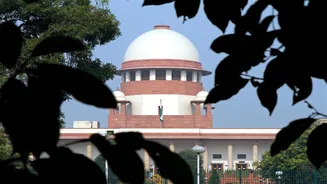
The Supreme Court on Wednesday (December 17) orally observed that the measures taken by authorities to curb pollution in Delhi have been a "total failure". The remarks came amid the deteriorating air quality in the national capital and the Air Quality Index plummeting to the 'severe' category.
A Bench led by Chief Justice of India Surya Kant remarked that any meaningful reduction in pollution would require broader and long-term planning rather than ad-hoc responses, news agency ANI reported.
The court observed that air pollution crisis is an annual feature and asked the Centre for Air Quality Management (CAQM) to revisit its long-term measures to deal with the menace. The apex court asked the CAQM and NCR governments to consider issues like urban mobility, incentivising farmers to stop stubble burning.
"Air pollution has become an annual feature. A long-term plan needs to be given effect to. The CAQM, being an expert body, is requested to revisit long-term measures..." the CJI said.
The court also asked the National Highway Authority of India (NHAI) and Municipal Corporation of Delhi (MCD) to decide in one week on closing its nine toll plazas for the time being.
When petitions highlighted inadequacies of recent measures aimed at protecting children, such as the Delhi government's directives to shut schools or allowing them to function in a hybrid mode, the top court noted that these were merely temporary policy decisions taken by the authorities to mitigate health risks. Thus, the bench refused to interfere in the Delhi government's decision to direct the shutting of schools or the hybrid model of schools.
"The short-term measures are only to provide temporary protection to children and elderly persons. These are purely interim policy decisions. At best, they can be viewed as an extension of vacations, as schools are anyway scheduled to remain closed for 10 to 15 days during the winter," the court observed.
A Bench led by Chief Justice of India Surya Kant remarked that any meaningful reduction in pollution would require broader and long-term planning rather than ad-hoc responses, news agency ANI reported.
The court observed that air pollution crisis is an annual feature and asked the Centre for Air Quality Management (CAQM) to revisit its long-term measures to deal with the menace. The apex court asked the CAQM and NCR governments to consider issues like urban mobility, incentivising farmers to stop stubble burning.
"Air pollution has become an annual feature. A long-term plan needs to be given effect to. The CAQM, being an expert body, is requested to revisit long-term measures..." the CJI said.
The court also asked the National Highway Authority of India (NHAI) and Municipal Corporation of Delhi (MCD) to decide in one week on closing its nine toll plazas for the time being.
When petitions highlighted inadequacies of recent measures aimed at protecting children, such as the Delhi government's directives to shut schools or allowing them to function in a hybrid mode, the top court noted that these were merely temporary policy decisions taken by the authorities to mitigate health risks. Thus, the bench refused to interfere in the Delhi government's decision to direct the shutting of schools or the hybrid model of schools.
"The short-term measures are only to provide temporary protection to children and elderly persons. These are purely interim policy decisions. At best, they can be viewed as an extension of vacations, as schools are anyway scheduled to remain closed for 10 to 15 days during the winter," the court observed.