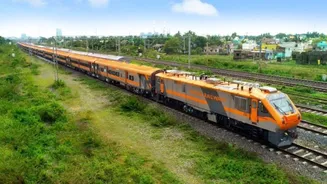

According to divisional officials, the loop-line speed has been increased from 15 km/h to 30 km/h. The upgrade affects a number of stations, including Kulpahar, Charkhari Road, Teharka, and Ranipur Road, all on the Veerangana Laxmibai Jhansi–Mahoba section.
"Continuous steps are being taken in the division to reduce travel time," said division's DRM, Anirudh Kumar.
Under the previous arrangement, trains switching over to loop lines had to slow down significantly, often causing delays in arrival and departure times. With the loop-line speed doubled:
- Ordinary trains will move through loop sections much faster, improving punctuality at each of the upgraded stations.
- Even when mail and express trains — including top-tier services such as Vande Bharat Express or Rajdhani Express — use the main line, other trains placed on loop lines will no longer crawl at 15 km/h; they can now maintain 30 km/h.
- Trains no longer need to queue waiting for the loop line to clear. Faster clearance of loop tracks helps streamline traffic flow on both main and loop lines.
Indian Railways says this is part of a nationwide initiative — with loop-line track repairs underway at multiple stations — aimed at raising loop-line speeds across the country, progressively improving rail traffic efficiency and reducing travel times.
For commuters traveling via the Jhansi network, these upgrades are expected to translate into earlier arrivals, shorter travel durations, and smoother journeys overall.