







What is the story about?
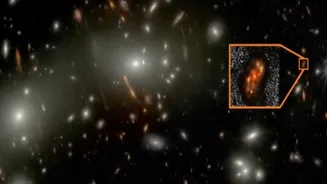
Astronomers in Pune have announced a discovery that is rewriting what we believed we knew about the early universe. Using images from theJames Webb Space Telescope (JWST), researchers at the National Centre for Radio Astrophysics (NCRA-TIFR) have found a massive, well-formed spiral galaxy that existed around 12 billion years ago, when the universe was only 1.5 billion years old.
The galaxy, named Alaknanda (after a river in the Himalayas), has a classic ‘grand-design’ spiral morphology with star-forming clusters and a brilliant centre bulge encircled by two symmetric spiral arms. This structure is strikingly similar to our Milky Way galaxy.
What makes Alaknanda unique is its unexpectedly mature appearance for its age. According to conventional beliefs, galaxies would be disorganised, compact, and unstable during the early stages of the cosmos.
Instead, Alaknanda's spiral arms and ordered disc imply that massive, disk-dominated spiral galaxies might have originated far sooner than originally believed.
The study estimates that Alaknanda is around 30,000 light-years in diameter and has accumulated a stellar mass comparable to billions of suns. Its star-formation rate, or the rate at which new stars are formed, is several times higher than the Milky Way's current pace, suggesting a rapid and active stage of early cosmic assembly.
In addition toJWST's strong infrared eyesight, the finding was made possible by a phenomenon known as gravitational lensing. The huge foreground cluster Abell 2744, also referred to as ‘Pandora's Cluster,’ allowed light from the galaxy to be twisted and amplified, making Alaknanda large and brilliant enough for close inspection.
The scientists behind the discovery, Rashi Jain and Yogesh Wadadekar, described the moment of discovery as ‘unexpected.’ According to Jain, Alaknanda was the only system having a distinct spiral shape out of more than 70,000 items studied.
“The galaxy appears extremely similar to our own Milky Way despite being present when the universe was only 10% of its current age,” Jain told the media.
“Finding such a well-formed spiral galaxy at this early stage is quite unexpected. It tells us that complex structures were being built in our universe much earlier than we believed possible,” she added.
Galaxy Alaknanda challenges long-held theories of galaxy formation, which maintained that stable spiral galaxies could only form after billions of years of comparatively quiet cosmic evolution.
According to the NCRA-TIFR team, further observations are scheduled. They intend to determine precisely how such a galaxy developed so fast by examining the movements of stars and gas within Alaknanda using spectroscopic data from JWST (and potentially other telescopes like Atacama Large Millimetre/submillimetre Array, ALMA).
Since its December 2021 launch, JWST has generated data, revolutionising our knowledge of the cosmos. This involves identifying some of the universe's earliest galaxies, which were created only a few hundred million years after the Big Bang.
The galaxy, named Alaknanda (after a river in the Himalayas), has a classic ‘grand-design’ spiral morphology with star-forming clusters and a brilliant centre bulge encircled by two symmetric spiral arms. This structure is strikingly similar to our Milky Way galaxy.
What makes Alaknanda unique is its unexpectedly mature appearance for its age. According to conventional beliefs, galaxies would be disorganised, compact, and unstable during the early stages of the cosmos.
Instead, Alaknanda's spiral arms and ordered disc imply that massive, disk-dominated spiral galaxies might have originated far sooner than originally believed.
The study estimates that Alaknanda is around 30,000 light-years in diameter and has accumulated a stellar mass comparable to billions of suns. Its star-formation rate, or the rate at which new stars are formed, is several times higher than the Milky Way's current pace, suggesting a rapid and active stage of early cosmic assembly.
In addition toJWST's strong infrared eyesight, the finding was made possible by a phenomenon known as gravitational lensing. The huge foreground cluster Abell 2744, also referred to as ‘Pandora's Cluster,’ allowed light from the galaxy to be twisted and amplified, making Alaknanda large and brilliant enough for close inspection.
The scientists behind the discovery, Rashi Jain and Yogesh Wadadekar, described the moment of discovery as ‘unexpected.’ According to Jain, Alaknanda was the only system having a distinct spiral shape out of more than 70,000 items studied.
“The galaxy appears extremely similar to our own Milky Way despite being present when the universe was only 10% of its current age,” Jain told the media.
“Finding such a well-formed spiral galaxy at this early stage is quite unexpected. It tells us that complex structures were being built in our universe much earlier than we believed possible,” she added.
Galaxy Alaknanda challenges long-held theories of galaxy formation, which maintained that stable spiral galaxies could only form after billions of years of comparatively quiet cosmic evolution.
According to the NCRA-TIFR team, further observations are scheduled. They intend to determine precisely how such a galaxy developed so fast by examining the movements of stars and gas within Alaknanda using spectroscopic data from JWST (and potentially other telescopes like Atacama Large Millimetre/submillimetre Array, ALMA).
Since its December 2021 launch, JWST has generated data, revolutionising our knowledge of the cosmos. This involves identifying some of the universe's earliest galaxies, which were created only a few hundred million years after the Big Bang.